
Cheapest Twitter API 2026: 8 Providers Ranked by Real Per-1,000-Tweet Cost
We pulled real pricing pages, ran the math at three volume tiers, and ranked every major Twitter API provider by what you actually pay per 1,000 tweets, including hidden costs most comparison posts skip.

TL;DR: At 100,000 tweets per month, the cost difference between the cheapest and most expensive provider in this list is 100x. GetXAPI runs $5. The official X API runs $500. The eight providers in this post cover every major option a developer actually reaches for in 2026, and each entry breaks down what you pay at low volume (10K tweets/month), mid volume (100K), and high volume (1M+), including the billing traps that marketing pages skip. If you want the underlying methodology in more depth, our Twitter API cost benchmark runs the same math against a wider sample.
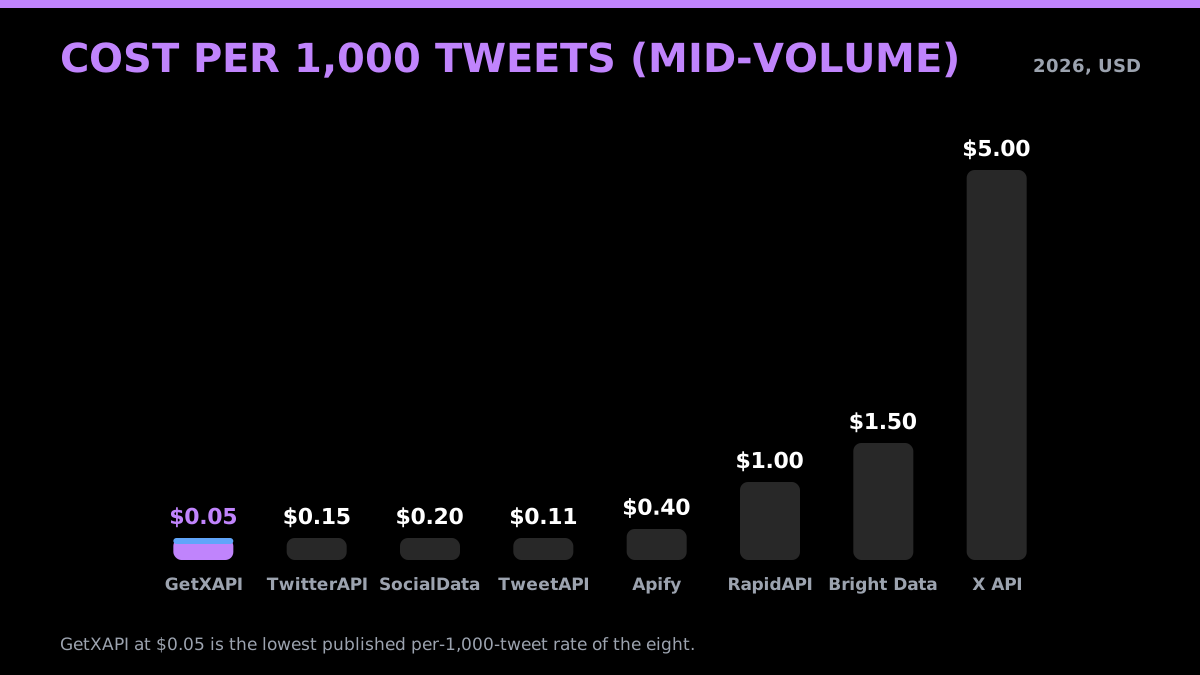
How we calculated per-1,000-tweet cost (the real math, not the marketing page)
Providers do not all bill in the same unit. The official X API bills per post read. GetXAPI bills per API call, where each call can return up to 20 tweets. Apify bills per compute unit and separately bills proxy bandwidth. Bright Data bills per record but adds residential proxy cost as a line item. RapidAPI listings sometimes bill per call AND per result simultaneously.
To make these comparable, we converted every pricing model to a single unit: the cost to get 1,000 tweets into your database, at three volume points.
Volume tiers used throughout this post:
- Low: 10,000 tweets per month
- Mid: 100,000 tweets per month
- High: 1,000,000 tweets per month
What counts as a tweet in billing: We use the number of tweet objects returned, not the number of HTTP requests fired. Where a single request returns 20 tweets (common in search endpoint pagination), we credit 20 tweets per call. The normalization is a one-liner:
def per_1k_tweets(unit_cost, tweets_per_unit):
    """Cost to retrieve 1,000 tweet objects, regardless of billing unit."""
    return (1_000 / tweets_per_unit) * unit_cost

print(per_1k_tweets(0.001, 20))   # GetXAPI: $0.001/call, 20 tweets -> 0.05
print(per_1k_tweets(0.005, 1))    # Official X API: $0.005/read -> 5.00
Failure rate adjustments: Where providers disclose or benchmarks show meaningful failure rates, we include a worst-case column. A 10% failure rate inflates your effective per-tweet cost by ~11%. A 37% failure rate (the low end of some scraping actors) inflates it by 59%. The adjustment is just dividing by the success rate:
def effective_cost(base_per_1k, failure_rate):
    """Inflate per-1k cost when you are billed for failed attempts too."""
    return base_per_1k / (1 - failure_rate)

print(effective_cost(0.40, 0.10))   # -> 0.444  (+11%)
print(effective_cost(0.40, 0.37))   # -> 0.635  (+59%)
What we excluded: API cost for writing (posting) is excluded from the ranked table, but we cover it in the official X API entry because the URL surcharge is a significant trap for publishing tools. We also excluded one-time setup costs, SDK licensing, and developer time. For a single-number reference on what each provider charges, our Twitter API cost guide keeps a running per-provider table.
The sources for each entry are linked inline, and the official rates are cross-checked against the X developer platform documentation where it publishes them. Where we relied on third-party benchmarks or operator disclosures, we say so.
1. GetXAPI: $0.05 per 1,000 tweets, the lowest rate in this ranking
Billing model: Flat $0.001 per API call. Each call to the search or timeline endpoints returns up to 20 tweet objects. That puts the effective cost at $0.05 per 1,000 tweets. A single search read looks like this:
curl "https://api.getxapi.com/twitter/tweet/advanced_search?q=web3&product=Latest" \
  -H "Authorization: Bearer $GETXAPI_KEY"   # one call, $0.001, up to 20 tweets
At our three volume tiers:
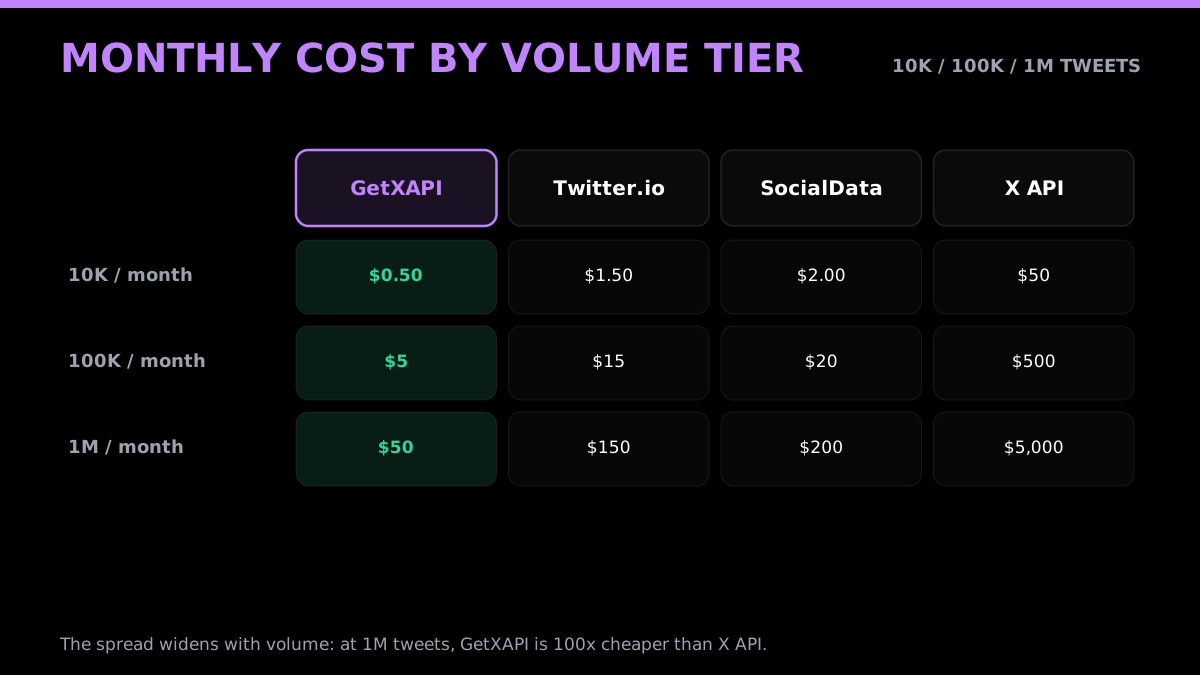
- 10K tweets/month: $0.50
- 100K tweets/month: $5.00
- 1M tweets/month: $50.00
No subscription required, no monthly minimum. You pay for calls made, and optional subscription plans are available if you want a lower effective per-call rate. If your pipeline is quiet in July, your July bill is quiet. New accounts receive $0.10 in free credits (roughly 2,000 tweets) with no credit card required at signup, per the published pricing page.
The 20-tweets-per-call math matters at scale. Providers that bill per tweet object (rather than per request) look equivalent on a per-item basis, but when your pipeline fires thousands of HTTP requests per day (whether through a library like requests or a higher-level SDK), the request-overhead billing from request-per-tweet models adds up. GetXAPI's model keeps per-call overhead fixed regardless of how many tweet objects come back in that response.
No developer account required. You do not need to apply for X API access, set up a developer account and app, or manage OAuth 2.0 tokens for the data source. GetXAPI handles authentication on your behalf. If you are weighing whether you even need official credentials, our breakdown of whether the Twitter API is still free walks through what the 2026 tiers actually grant. For teams that have been blocked from X API access or do not want to hold official API credentials for a scraping use case, this removes a meaningful setup burden, and our GetXAPI best practices guide covers how to structure calls for the lowest effective rate.
Infrastructure is included in the fee. Proxy rotation, rate limit management, and bot detection handling are absorbed by the service. You are not billed separately for the infrastructure that makes the calls work, unlike Bright Data's model where proxy bandwidth is a separate line item.
You can project a monthly bill from a single volume number:
PER_1K = {"getxapi": 0.05, "twitterapi_io": 0.15, "socialdata": 0.20, "x_api": 5.00}
monthly_tweets = 100_000
for name, rate in PER_1K.items():
    print(f"{name:14} ${monthly_tweets / 1_000 * rate:,.2f}")
    # getxapi -> $5.00, x_api -> $500.00 at 100K tweets
Real comparison at mid volume: At 100,000 tweets per month, GetXAPI costs $5 versus Apify pay-per-result actors at $18-40 (before platform overhead) and the official X API at $500. An independent side-by-side published on the GetXAPI blog found a 110x cost gap at this volume tier.
Who this works for: Research pipelines, sentiment monitoring tools, competitive intelligence scripts, and any project where tweet data is the input and cost control matters. If you are building one of these in Python, the Python Twitter API tutorial shows the call pattern end to end, and if you are coming from a library-first workflow, Tweepy is the long-standing open-source client most developers start with. Also works for early-stage projects where you want to test product-market fit before committing to a subscription.
The pain that drives most teams to compare these rates in the first place is visible all over X:
2. TwitterAPI.io: $0.15 per 1,000 tweets, pay-per-use with no floor or cap
Billing model: $0.00015 per read, pay-per-use. No monthly minimum. No subscription tier required. Per the TwitterAPI.io cost breakdown, new accounts receive a $1 trial credit, which covers roughly 6,667 tweet reads.
At our three volume tiers:
- 10K tweets/month: $1.50
- 100K tweets/month: $15.00
- 1M tweets/month: $150.00
Coverage: The service documents around 75 endpoints, covering tweet search, user lookups, timeline reads, trending topics, and more. The breadth is meaningful if your use case hits multiple endpoint types rather than a single search query. Teams already on it who want to consolidate onto cheaper pay-per-call billing usually start with our migrate from TwitterAPI.io to GetXAPI walkthrough.
No cap on reads. Where the official X API imposes a hard 3M reads per month ceiling before forcing an Enterprise negotiation, TwitterAPI.io has published no such cap. At 3M reads per month, TwitterAPI.io costs about $450, while the official API bills roughly $15,000 for the same volume, and that is where its pay-per-use path ends. If your concern is request throttling rather than the monthly cap, our Twitter API rate limit guide maps the per-window limits, and X's own rate-limit documentation lists the official ceilings per endpoint.
Cost versus the official X API at scale: Per the TwitterAPI.io pricing analysis, official pay-per-use runs about 33x the cost of TwitterAPI.io for the same reads ($5.00 versus $0.15 per 1,000). At the current 3M-read cap, that gap is roughly $15,000 versus $450 per month.
Failure billing: The service publishes no explicit failed-request billing policy in its pricing docs. Where a provider does not disclose this, treat it as an unknown risk at high volume.
Who this works for: Projects that need endpoint breadth (not just tweet search), developers who burned through trial credits on other services and want a flat-rate alternative, and teams migrating from the official API who want predictable billing without subscriptions.
3. SocialData.tools: $0.20 per 1,000 items, clean flat rate with one important exception
Billing model: $0.0002 per tweet or user profile returned. Failed requests are explicitly not billed, per the SocialData.tools pricing documentation. A free allowance of 3 requests per minute is available before charges begin, which gives small projects a real zero-cost starting point.
At our three volume tiers:
- 10K tweets/month: $2.00
- 100K tweets/month: $20.00
- 1M tweets/month: $200.00
The hidden cost to know: Extended bio lookups cost $0.001 per request, which is 5x the standard $0.0002 per-item rate. If your application fetches full user profiles, including complete bios and follower counts, you will hit the $0.001 rate more often than the standard rate suggests. A developer tool that pulls profiles for every tweet author at 100K tweets/month could find its effective rate closer to $0.50-1.00 per 1,000 items once profile lookups are factored in. The way you structure these queries matters: our how to scrape tweets guide and the reference on Twitter advanced search operators both show how tighter queries cut the number of profile round-trips you pay for.
No failure billing. The docs explicitly state that failed requests do not count against your balance. This is a meaningful detail at high volume, where scraping-based competitors often bill for compute and proxy costs even when no data is returned.
3 requests per minute free tier: This is enough for ad hoc exploration, testing integrations, or running a personal project at very low volume without touching a credit card. The billing clock starts once you exceed that threshold.
Who this works for: Developers who need a mix of tweet data and user profile data in the same pipeline, projects that want predictable per-item billing without subscriptions, and teams that want the no-failure-billing guarantee as a budget control.
Start building with GetXAPI
$0.05 per 1,000 tweets. $0.10 free credits. No credit card required.
4. TweetAPI.com: $0.10 to $0.17 per 1,000 requests, but subscription math cuts both ways
Billing model: Monthly subscription across three tiers. Published rates from the TweetAPI.com pricing guide:
| Tier | Monthly cost | Included requests | Effective rate |
|---|---|---|---|
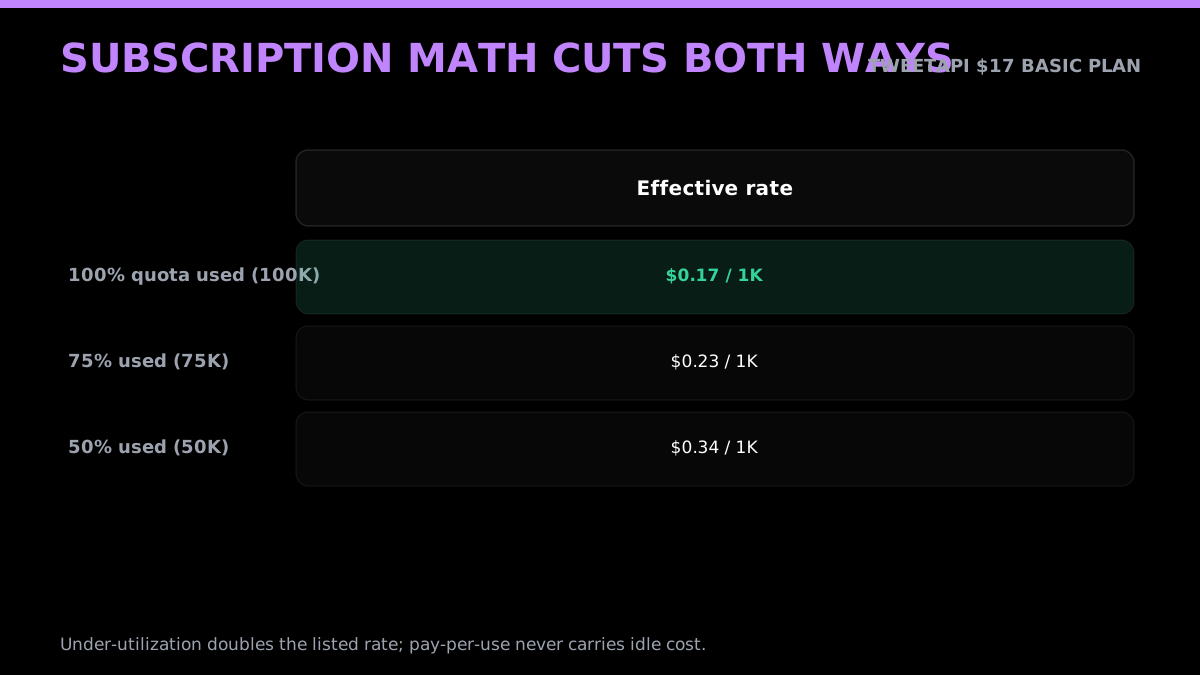
| Basic | $17/month | 100K requests | $0.17 per 1K |
| Standard | $57/month | 500K requests | $0.11 per 1K |
| Pro | $197/month | 2M requests | $0.10 per 1K |
The effective rate is the plan price divided by what you actually consume, not the included quota:
def effective_rate(plan_price, requests_used):
    return plan_price / (requests_used / 1_000)

print(effective_rate(17, 100_000))   # -> 0.17  (full quota)
print(effective_rate(17, 50_000))    # -> 0.34  (half used, rate doubles)
Why subscription math cuts both ways: If you use your full quota, the effective rate is competitive. If you use 50K requests on the $17/month Basic plan, your actual effective rate becomes $0.34 per 1,000, doubling the listed rate. This is not a billing quirk unique to TweetAPI, it is an inherent property of subscription pricing: the cost per unit is only the published rate when you hit 100% utilization.
Who benefits from fixed caps: Teams with consistent, predictable monthly volume and a pipeline that does not spike are the natural fit. If you know your pipeline pulls exactly 400K tweets every month, the $57 Standard tier gives you a clean $0.14 per 1K effective rate with no surprise bills.
Who gets hurt by it: Seasonal use cases, research projects with variable query volumes, or any pipeline where your needs vary month to month. In those cases, pay-per-use models will almost always be cheaper in the months where volume drops below plan capacity.
No mention of failure billing in public docs. Subscription models typically include all requests fired regardless of whether the upstream source returns data, because the quota is consumed at request time. This should be verified before committing to a plan if your use case has any failure-prone data sources.
Who this works for: Teams with consistent monthly request volumes who want predictable billing and are comfortable with subscription cost-of-carry. If you are still wiring up your first integration, the Twitter API tutorial for 2026 covers auth and pagination regardless of which provider you land on. Not a fit for variable-volume or seasonal projects.
Developers hit this subscription trap often enough that it shows up in the open:
I tried the new X API - it's nice, but doesn't look so cheap
5. Apify: $0.18 to $0.40 per 1,000 tweets listed, but real total cost is higher
Billing model: Pay-per-result actor pricing on the two main Twitter actors. Published rates from Apify actor listings and the Apify pricing guide:
- kaitoeasyapi actor: $0.25 per 1,000 results
- apidojo V2 actor: $0.40 per 1,000 results
These are the per-result rates before platform overhead. The listed cost is rarely what you pay.
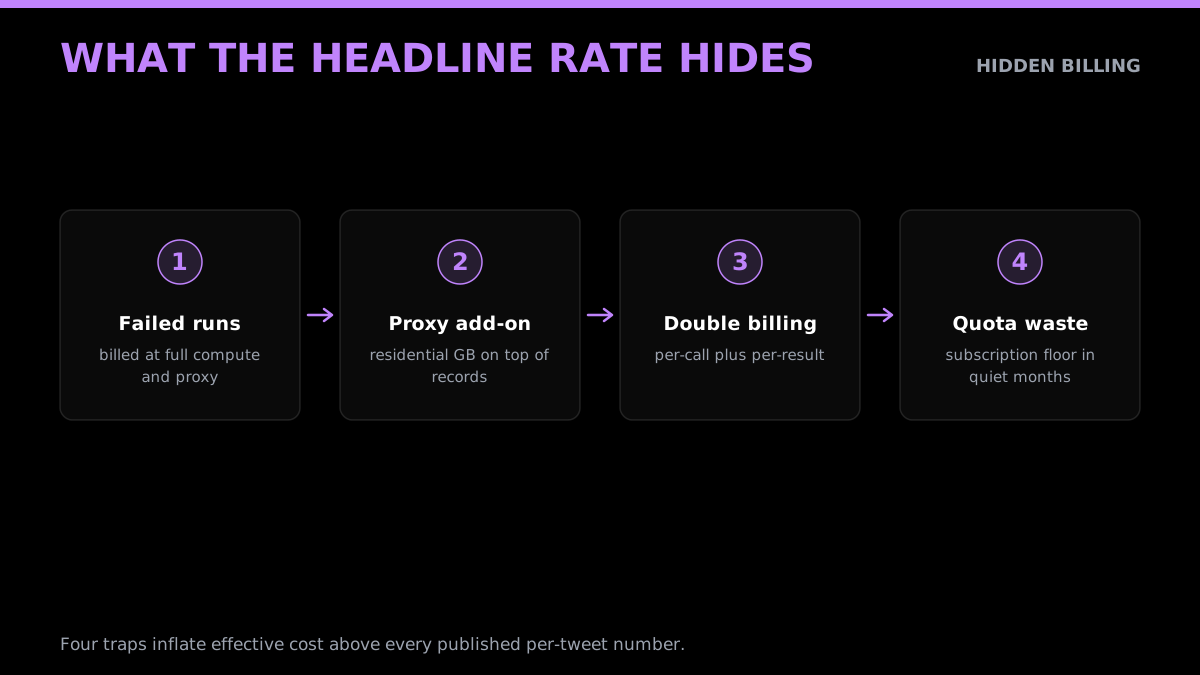
The failed-run billing problem. When a scraping run encounters a proxy timeout, bot detection, or a rate limit block, Apify bills the full compute unit and proxy cost for that run even when zero tweets are returned. This is documented in Apify's platform pricing documentation. At normal failure rates for Twitter scraping (which can run 10-37% depending on proxy configuration and actor choice), this meaningfully inflates effective cost. Proxy configuration is the single biggest lever on that failure rate, which is why our guide to the best residential proxies for Twitter scraping is worth reading before you commit to an actor-based pipeline.
Platform add-ons that stack: Beyond the per-result actor fee, Apify adds:
- Concurrent run fees ($5 per concurrent run on default plan)
- Dataset storage (charged per GB stored per month)
- Data transfer fees
- Separate proxy costs if you upgrade from shared to residential proxies
Independent analysis found that these platform overhead charges add 30-50% on top of quoted per-tweet actor rates at typical usage patterns. A six-month TCO projection comparing Apify to flat-fee alternatives found Apify ranging $120-200 per month for 200K tweets per month, versus $10 on flat-fee alternatives at the same volume.
When Apify's batch model makes sense despite the premium: Apify offers something the other providers in this list do not: a full managed scraping infrastructure where you can swap actors, chain tasks, build scheduled runs, and integrate with hundreds of downstream services via Apify's API. If Twitter scraping is one step in a larger multi-source pipeline that also hits LinkedIn, Amazon, or other properties, the unified billing and orchestration layer can be worth the per-tweet premium. You are paying for the platform, not just the data.
Practical floor: At 100K tweets per month on kaitoeasyapi, the base cost is $25. After factoring average failure rates and platform overhead, realistic total cost lands in the $35-50 range, versus $5 at GetXAPI for the same volume.
Who this works for: Teams already running multi-source Apify pipelines who want to add Twitter data within their existing infrastructure, not greenfield projects where cost is the primary constraint. For a head-to-head on the exact tweet-scraping use case, see our Apify Twitter scraper vs GetXAPI breakdown, and if you are still picking a tool, the best Twitter API for scraping comparison ranks the field on reliability as well as price.
6. RapidAPI marketplace: $0.50 to $5.50 per 1,000 tweets depending on the listing
Billing model: Marketplace, meaning each listing sets its own rate and billing model. RapidAPI takes approximately 20% of publisher revenue as a marketplace fee, baked into the price you see displayed. The result is a wide range of effective per-tweet costs within a single platform.
From the RapidAPI marketplace analysis, rate categories break down roughly as:
- Popular scraping wrappers: $0.50-1.50 per 1,000 tweets
- Unofficial API wrappers: $1.50-3.00 per 1,000 tweets
- Data aggregators: $2.00-5.50 per 1,000 tweets
At our three volume tiers (mid-tier listing at $1.00/1K):
- 10K tweets/month: $10.00
- 100K tweets/month: $100.00
- 1M tweets/month: $1,000.00
The double-billing trap. Some RapidAPI listings charge both a per-call counter and a per-result counter simultaneously. You pay once when the HTTP request is fired and again for each tweet object returned. At high volume, this compounds quickly and is often buried in the listing's detailed pricing page rather than the headline rate.
Failure billing: Most listed providers charge against your plan tier whether the API response succeeded or not. Because RapidAPI sits between you and the actual provider, refund policies vary and can be slow to resolve.
Marketplace fee math. The ~20% RapidAPI takes from publishers is passed to you in the displayed price. The same underlying provider offering a service at $0.80/1K directly will often appear at $1.00/1K on RapidAPI. Buying direct from the provider, when they offer a direct purchase option, almost always costs less. The per-result counter only makes sense once you know how the underlying read works, which X documents in its post lookup reference.
Who this works for: Developers who want to test multiple Twitter data providers within a single unified API key and billing account, without managing separate accounts at each vendor. The convenience premium is real and can be worth it for early prototyping. It is rarely the right call for production workloads where cost matters.
7. Bright Data: $0.75 to $2.50 per 1,000 records, highest success rate in benchmarks
Billing model: Pay-as-you-go at $1.50 per 1,000 records. Scale plan at $499/month for 384K records ($1.30 per 1K). A promotional code (APIS25) cuts the PAYG rate to $0.75/1K for the first three months, per Bright Data's pricing and benchmark blog.
At our three volume tiers (PAYG rate, no promo):
- 10K tweets/month: $15.00
- 100K tweets/month: $150.00
- 1M tweets/month: $1,500.00
The proxy add-on cost. Bright Data's per-record rate does not include the cost of the residential proxy network used to fetch the data. Residential proxies are billed separately:
- Pay-as-you-go: $8.40 per GB
- Committed: $3.00 per GB
Twitter's average page payload runs roughly 0.5-2 MB per scraping request depending on thread depth. For a proxy-heavy crawl (common when Twitter has heightened bot detection), proxy costs can add $1-4 per 1,000 records on top of the base rate. The effective cost range of $0.75-2.50 per 1K records captures this spread, but your specific number depends on crawl strategy and proxy tier.
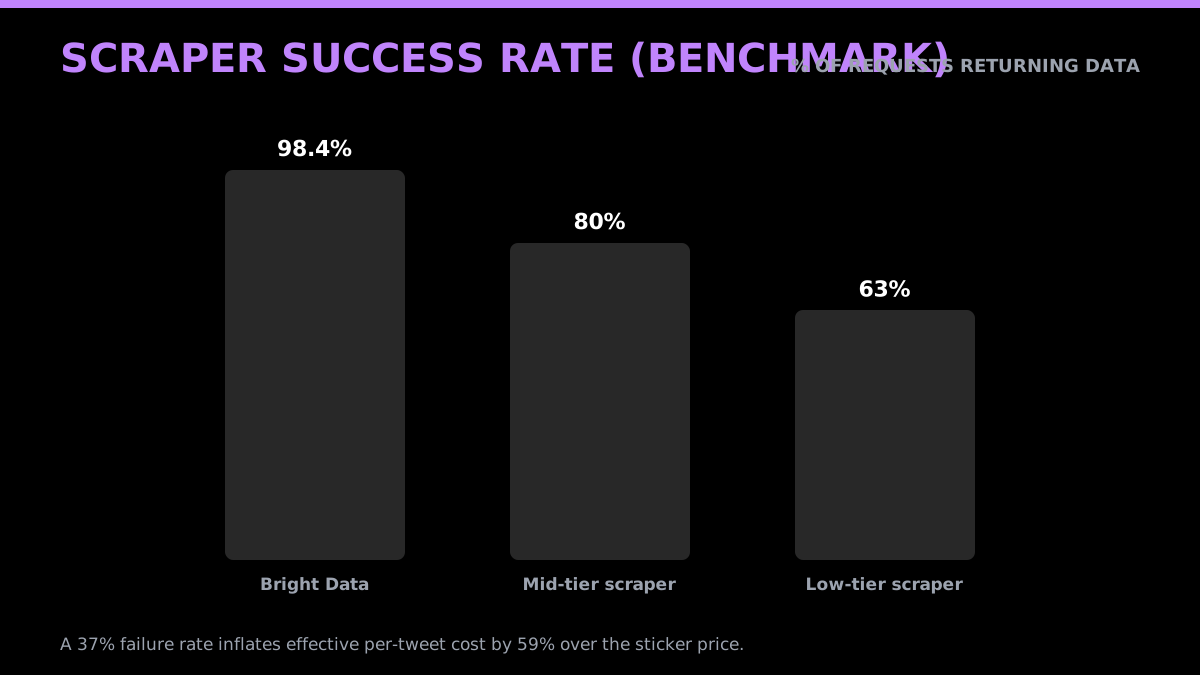
The success rate case. Per an independent benchmark of 11 Twitter data providers run in 2026, Bright Data recorded a 98.44% average success rate, the highest of any provider tested. Most scraping-based competitors achieved 63-95% success rates. At a 37% failure rate, you are paying for data you do not receive, which inflates effective per-tweet cost by 59% over what the per-record price suggests. The failures that drag those numbers down are mostly bot-detection blocks, and our Twitter bot detection guide explains why managed providers absorb that risk where DIY scrapers eat it.
Volume discounts. Volume discounts on Bright Data's proxy network become meaningful above approximately $200 per month in spend. There is no hard monthly minimum, but the unit economics improve noticeably at committed volume.
When the reliability premium pays off: Research projects where data completeness matters more than per-tweet cost, compliance-sensitive pipelines where a 37% missing data rate would invalidate the analysis, and enterprise use cases where Bright Data's auditable data lineage and SLAs matter more than raw price.
Who this works for: Data teams with budget headroom that need the highest completion rate available. Not the right tool for cost-sensitive or high-volume pipelines where a 20x price premium over GetXAPI would dominate the budget.
The cheapest Twitter API. Try it free.
$0.05 per 1,000 tweets. $0.10 free credits. No credit card required.
8. Official X API: $5 per 1,000 tweet reads, plus a URL surcharge that costs more than you expect
Billing model: The current official page lists prepaid pay-per-use and custom Enterprise access. It does not list general public Free, Basic, or Pro plans and does not publish a complete migration history. We track the source boundaries in our 2026 X API pricing guide, and X publishes current prices on its official pricing page:
| Operation | Rate |
|---|---|
| Post read (pay-per-use) | $0.005 per read |
| Post creation (plain text) | $0.015 per post |
| Post creation with URL | $0.20 per post |
| Owned read, when authenticated user ID equals app owner user ID | $0.001 per resource |
At our three volume tiers (read-only use case):
- 10K tweets/month: $50.00
- 100K tweets/month: $500.00
- 1M tweets/month: $5,000.00
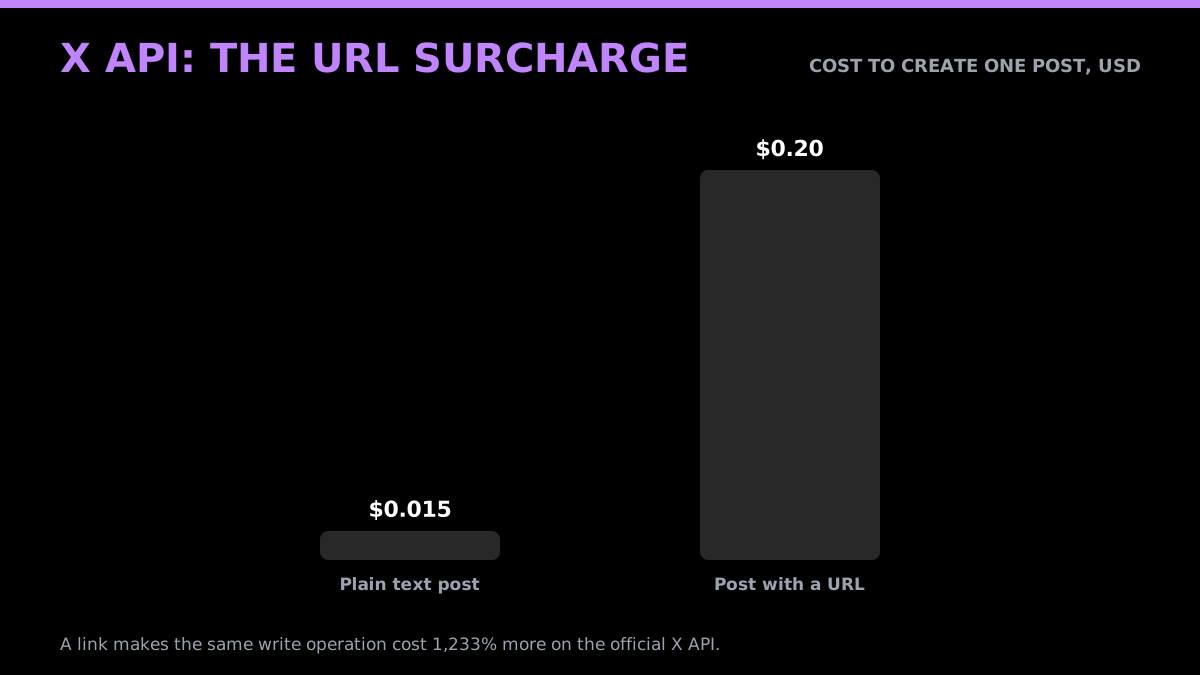
The URL surcharge is the biggest trap for publishing tools. A plain post costs $0.015 to create. A post containing a URL costs $0.20. That is a 1,233% premium for the same write operation with a link in it. Per Blotato's Twitter API pricing analysis: a social scheduling tool sending 3,000 posts per month with 50% link posts pays approximately $325 per month under pay-per-use. If all posts were plain text, the same volume would cost approximately $45. The link adds $280.
Developers who watch their per-read bill closely have already done this arithmetic in public:
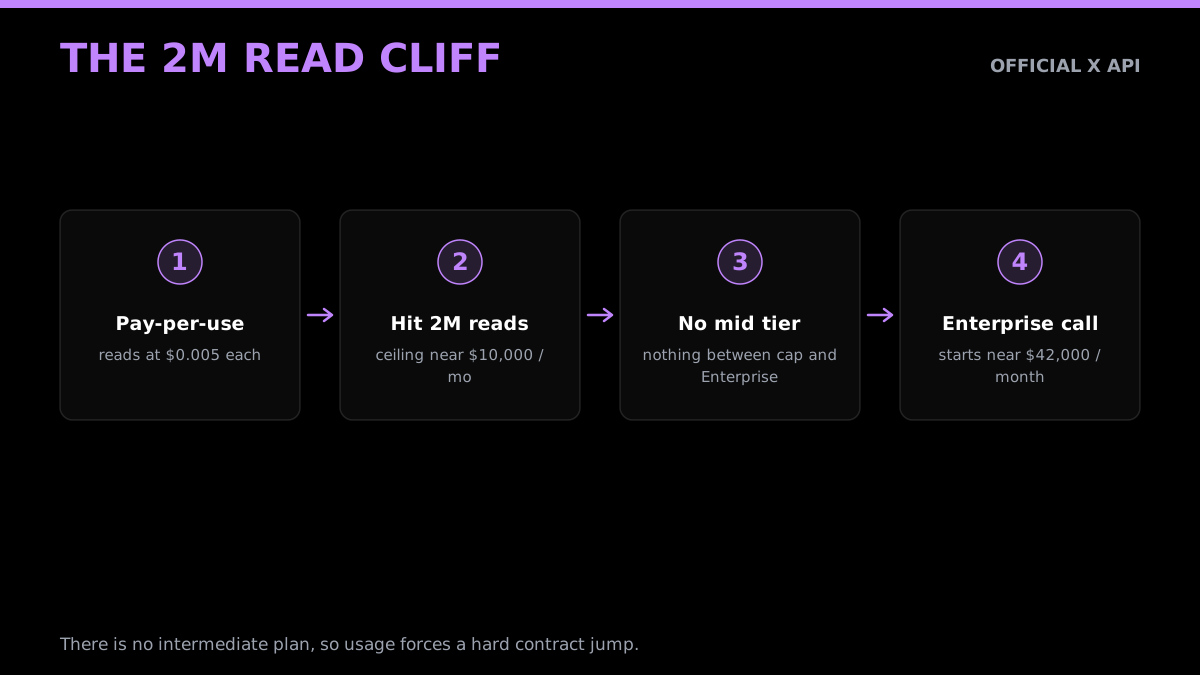
The 3M Post-read cap. The public pay-per-use table caps Post reads at 3M per month. The official page then lists Enterprise access as custom priced. It does not publish a fixed starting price, so any workload above public self-serve terms needs an actual quote. If you are pulling large historical windows, that ceiling arrives faster than you expect, which our guide to scraping tweet history via API accounts for.
The owned-read price. The current table lists $0.001 per owned resource only when the authenticated user ID is the same as the app owner's user ID. The page does not establish an April effective date or a prior price, so this should be presented as a current price with its identity condition, not as a dated reduction.
No general public Free tier listed. The current pricing page lists pay-per-use and Enterprise access and does not document a universal voucher or migration path. If you want to try the official route, our walkthrough on how to get a Twitter API key covers the current signup flow; check the Developer Console for account-specific terms.
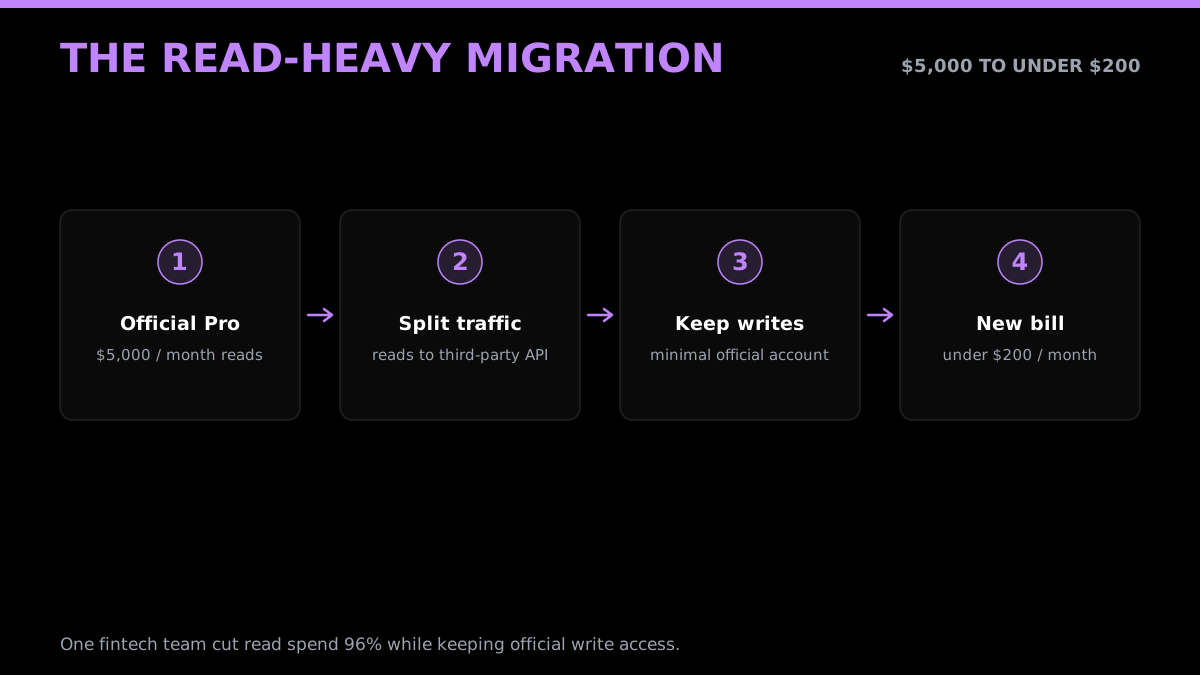
A practitioner's take: A data engineer working on a fintech social sentiment pipeline told the Sorsa API blog that their team dropped from $5,000 per month to under $200 after migrating from the official Pro plan to a third-party provider, a 96% cost reduction, while keeping a minimal official API connection only for direct-post operations. The arithmetic on that migration is straightforward: the official API rates make sense when you need official compliance guarantees or are writing to X on behalf of verified accounts. They rarely make sense for read-heavy research pipelines.
The same frustration surfaces constantly in developer communities:
What is going on with Twitter (X) API pricing???
On Hacker News in 2026, the xAPIs.dev creator posted a Show HN describing the exact decision point that drives most migrations: "The X API pricing killed my side project," followed by shipping a sub-$10/month alternative targeting indie devs, researchers, and startups who need Twitter data without enterprise budgets. A commenter noted: "X API pricing definitely pushed many indie devs toward client-side solutions instead."
Who actually should use the official X API in 2026: Teams with compliance requirements that mandate official API access (regulated industries, verified business accounts posting at scale), anyone posting content to X at volume and needing official write endpoints, and situations where contractual SLAs from X itself are a business requirement. For read-only research and data pipelines, the cost case is almost never competitive with third-party alternatives.
How to pick: volume, use case, and a decision matrix
There is no single right answer. The best provider depends on what you are building, how much data you need, and whether you optimize for unit cost, success rate, endpoint breadth, or operational simplicity.
By volume
Under 50K tweets per month: At this volume, the absolute dollar difference between providers is small. GetXAPI at $2.50 per month versus RapidAPI at $25 per month is a $22.50 difference, material for a side project, immaterial for a funded team. At this tier, optimize for ease of integration and endpoint coverage over cost. TwitterAPI.io's free $1 credit and SocialData.tools' 3-req/min free tier let you start shipping before committing any budget.
50K to 500K tweets per month: This is where provider choice meaningfully changes your P&L. The spread runs from $2.50 (GetXAPI) to $250+ (official API) per 100K tweets. Pay-per-use providers (GetXAPI, TwitterAPI.io, SocialData.tools) beat subscriptions unless you can predict and hit your quota consistently. Apify becomes hard to justify against flat-fee alternatives at this tier once platform overhead is included.
Above 500K tweets per month: GetXAPI at $50 per 1M tweets versus the official API at $5,000 is a 100x gap that compounds every month. At this scale, the provider decision is the biggest budget lever in your stack. Pay-per-use providers with no monthly read cap (GetXAPI, TwitterAPI.io) scale linearly. Subscription providers require custom Enterprise negotiation. The official API forces a hard contract upgrade at 3M reads.
By use case
Read-heavy research (sentiment analysis, academic datasets, competitor monitoring): Cost per tweet is the primary variable. GetXAPI at $0.05 per 1K and TwitterAPI.io at $0.15 per 1K are the options to evaluate first. Bright Data makes sense only when data completeness guarantees matter more than per-tweet cost. If sentiment is your workload, our Twitter sentiment analysis in Python guide pairs the cheap-read path with a working classifier, and academic teams sizing a dataset should note that Pew Research's work on how Americans use X is a useful benchmark for representativeness against the platform's global user base.
Write-heavy publishing (social scheduling, cross-posting tools): The official X API is the only legitimate path for write operations. Factor the URL surcharge into your per-post cost from day one. A tool that posts primarily link-containing posts will pay approximately 13x more per post than one posting plain text. Build your pricing model around $0.20 per post, not $0.015. Write endpoints extend beyond plain posts too: if your product touches DMs or long-form, see how to send Twitter DMs via API and the Twitter article API tutorial for the surfaces and their costs.
Mixed read-write pipelines: The standard pattern in 2026 is a hybrid: official X API for write endpoints (where you need official access anyway), plus a third-party provider for read/search/monitoring at lower cost. The split bill is easy to model:
def hybrid_monthly(read_tweets, posts, third_party_per_1k=0.05, post_cost=0.015):
    reads = read_tweets / 1_000 * third_party_per_1k   # third-party reads
    writes = posts * post_cost                          # official writes
    return reads + writes

print(hybrid_monthly(100_000, 3_000))   # -> 50.0  reads + 45.0 writes = $95.0
A fintech team paying $5,000/month on the official Pro plan for read-only sentiment analysis and $45/month for posting can restructure to $200/month on a third-party for reads plus a minimal official account for writes.
Bulk historical data: For pulling large historical tweet archives (months to years of data on a topic or account), check whether your target provider has rate limits on historical search depth. The official API limits free-tier historical access; third-party providers vary. The depth of your query is what determines how many calls you pay for, and X documents the operator set in its build-a-query reference. Batch actor models like Apify can work for one-time historical pulls where the per-run failure overhead is acceptable for a non-recurring cost. Exports of a specific account's audience follow a similar pattern, covered in how to export Twitter followers via API.
Picking the wrong tier is one of the most common early mistakes, and watching one walkthrough end to end short-circuits a lot of trial and error:
https://www.youtube.com/watch?v=qSIONwzLfFY
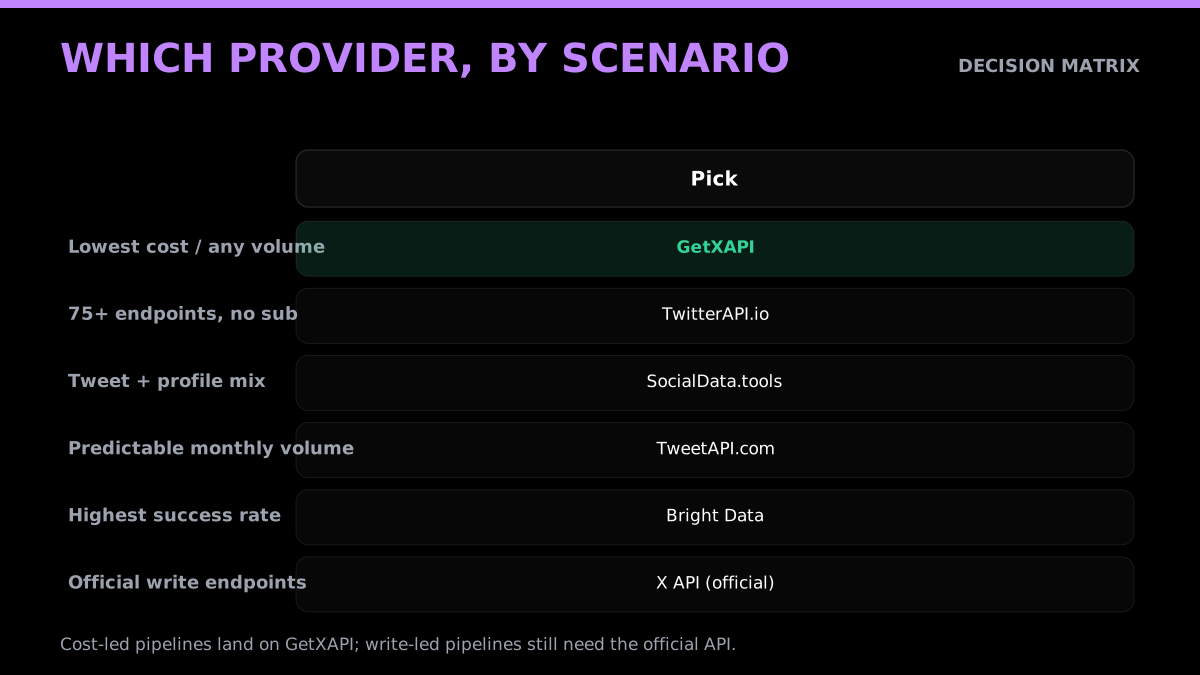
Decision matrix
| Scenario | Recommended provider | Why |
|---|---|---|
| Lowest cost per tweet, any volume | GetXAPI | $0.05/1K, no minimum, no proxy add-on |
| Need 75+ endpoints without subscription | TwitterAPI.io | $0.15/1K, broadest coverage per cost |
| Mixed tweet + profile data | SocialData.tools | $0.20/1K tweets, $0.001/profile (plan for the premium) |
| Consistent, predictable monthly volume | TweetAPI.com | Subscription efficiency if you hit your quota |
| Already on Apify for multi-source pipeline | Apify | Platform consolidation offsets per-tweet premium |
| Prototyping across multiple providers | RapidAPI | Unified billing for exploration, not production |
| Highest success rate matters most | Bright Data | 98.44% benchmark, residential proxy reliability |
| Official write endpoints required | X API (official) | The only compliant path for write operations |
One scenario the matrix above does not break out separately is trends and topic monitoring, which most providers expose through a dedicated endpoint covered in our Twitter trends API guide. And if you are specifically weighing a third-party against staying on the official v2 endpoints, the Twitter API v2 vs GetXAPI comparison runs that decision in isolation. And if your stack needs more than raw data access, schedulers, analytics, or monitoring, the best Twitter/X tools in 2026 roundup covers the full landscape by category.
The hidden costs summary
Every pricing table you find in a Google search will show you the headline rate. Here is what the headline rate leaves out, organized by provider:
Official X API: The $0.20 per post URL surcharge is the biggest billing shock for teams migrating from legacy plans. At 3,000 posts per month with 50% link posts, that surcharge adds $280 above what plain-text post cost would suggest. The 3M read hard cap with no intermediate upgrade path is the second most common surprise, forcing teams to negotiate Enterprise contracts far earlier than their usage would otherwise require.
Apify: Failed runs are billed at full compute and proxy cost. A Twitter scraping run that returns zero tweets because of bot detection still consumes your compute quota and charges proxy bandwidth. At typical scraping failure rates, this inflates effective per-tweet cost by 10-50% above the published per-result actor rate. Concurrent run fees, dataset storage, and data transfer add a further 30-50% platform overhead on top of quoted rates.
RapidAPI: The marketplace fee of approximately 20% is baked into displayed prices. Buying from the underlying provider directly, when that option exists, removes this layer. Per-call AND per-result double billing exists on specific listings, check the detailed pricing tab before committing. Failure billing policies vary by listing and refund resolution can be slow.
Bright Data: Residential proxy costs ($3.00-8.40 per GB) are a separate line item from the per-record fee. For proxy-heavy Twitter crawls, the proxy cost can double the effective per-record rate. The APIS25 promo code cuts the PAYG rate to $0.75/1K for the first three months but reverts to $1.50/1K after.
SocialData.tools: The extended bio endpoint at $0.001 per request is 5x the standard $0.0002 rate. Pipelines that pull full user profiles for every tweet author will find this endpoint dominating their bill at scale.
TweetAPI.com: Subscription under-utilization is the cost trap. The $17/month Basic plan costs $0.34 per 1K effective rate if you only use 50K of your 100K quota. Variable-volume projects pay the subscription floor even in quiet months.
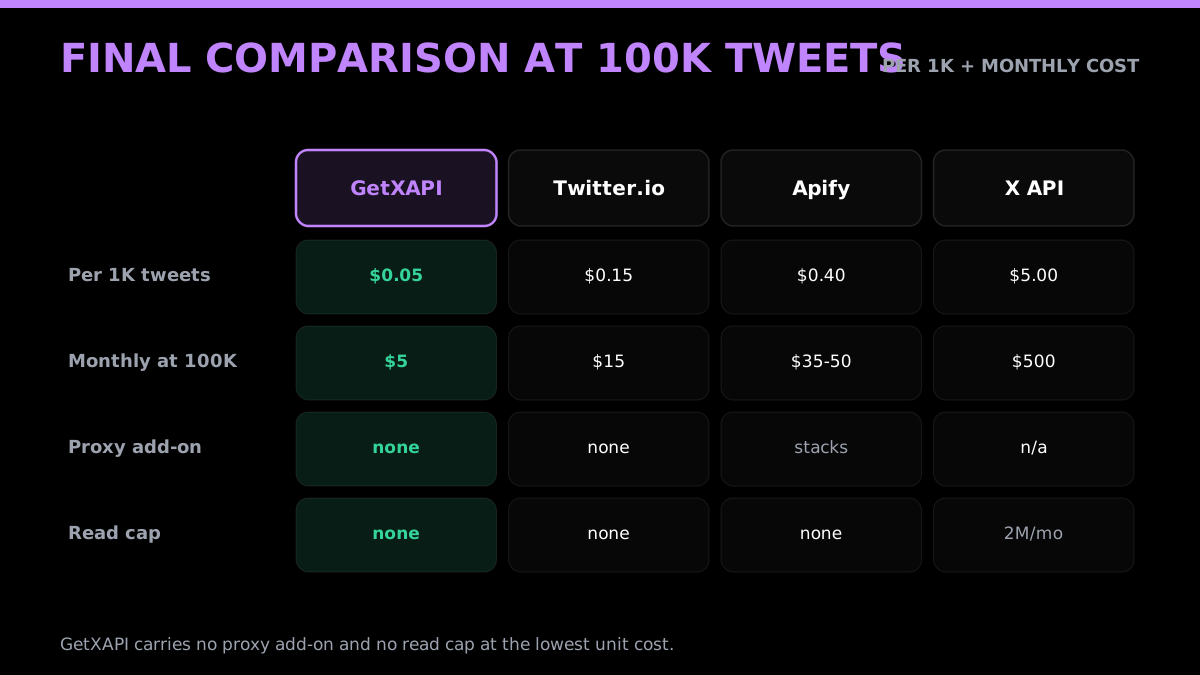
Final comparison table
| Provider | Per 1K tweets (mid-vol) | Monthly at 100K | Notes |
|---|---|---|---|
| GetXAPI | $0.05 | $5 | No minimum, no proxy add-on |
| TwitterAPI.io | $0.15 | $15 | 75 endpoints, pay-per-use |
| SocialData.tools | $0.20 | $20 | Profile endpoint is $0.001 |
| TweetAPI.com | $0.11 | $57 (subscription) | Effective rate assumes full quota use |
| Apify | $0.25-0.40 (+ overhead) | $35-50 est. | Platform overhead adds 30-50% |
| RapidAPI | $0.50-5.50 | $50-550 | Varies by listing |
| Bright Data | $1.50 (+ proxy) | $150-300 | Highest success rate (98.44%) |
| Official X API | $5.00 | $500 | $0.20/post with URL, 3M read cap |
All figures at 100,000 tweets per month. Bright Data includes estimated proxy overhead. Apify estimate includes 30% platform overhead. Official X API rate is read-only; write operations billed separately.
If you are starting fresh and want one tutorial that ties the cheapest path together, the complete Twitter API tutorial for 2026 is the place to begin.
The same cost calculus shows up in scraping threads, where developers keep asking for a workable path:
Is there a current solution to scrape tweets?
The 100x spread between GetXAPI and the official X API at 100K tweets per month is not a pricing anomaly. It reflects a structural difference in who is absorbing infrastructure cost. Third-party providers compete on price because they have to. The official API sets prices based on what the platform can extract from teams that need official write access or compliance guarantees.
For most read-heavy developer use cases in 2026, the migration math is straightforward. The question is which third-party provider matches your endpoint coverage, volume profile, and tolerance for failure-rate risk. That answer depends on your specific pipeline, which is why the decision matrix above is the output, not a single winner.
Frequently Asked Questions
GetXAPI at $0.001 per API call (roughly $0.05 per 1,000 tweets) is the lowest published rate among the eight providers ranked here as of 2026. There is no monthly minimum, no subscription required, and $0.10 in free credits at signup. Optional subscription plans are also available at a lower effective per-call rate.
The current public X pricing page does not list a general public Free tier. It lists prepaid pay-per-use and custom Enterprise access. The page does not publish a universal migration voucher or a complete history for legacy accounts.
Yes. Third-party providers like GetXAPI, TwitterAPI.io, SocialData.tools, TweetAPI.com, Apify actors, RapidAPI listings, and Bright Data all provide Twitter data access without requiring you to hold an X developer account. These services handle the authentication layer on your behalf.
GetXAPI is significantly cheaper. At 100,000 tweets per month, GetXAPI costs $5 versus Apify pay-per-result actors running $18-40 at published rates before adding failed-run billing, compute units, proxy variance, and storage fees. Independent analysis found a 110x cost gap at that volume tier.
The official X API charges $0.005 per post read on the pay-per-use tier, which works out to $5.00 per 1,000 tweet reads. Posts that contain a URL cost $0.20 each to create, a 1,233% premium over plain posts at $0.015.
The main hidden costs are: Apify billing for failed scraping runs at full compute and proxy cost, the official X API URL surcharge ($0.20 per post with link vs $0.015 without), RapidAPI listings that charge both per-call and per-result simultaneously, Bright Data's residential proxy add-on ($3-8.40 per GB on top of per-record fees), and TweetAPI subscription under-utilization doubling your effective rate.
The public pay-per-use table lists a 3M monthly Post-read cap. Enterprise is the custom-priced path for negotiated access above public self-serve terms. X does not publish a fixed Enterprise monthly floor on the current pricing page.
Check out similar blogs
More guides on the Twitter/X API, scraping, and pricing.

7 Twitter API Use Cases With No X Developer Account (2026)
The current public X pricing page lists pay-per-use and Enterprise access. Here are 7 Twitter data use cases you can ship without an X developer account.

How to Search Tweets by Hashtag with the X API
Tested X API hashtag queries: how the # operator differs from a plain keyword, combining hashtags, Top versus Latest, filters that work, and cursor pagination.

X (Twitter) API Object Reference: Tweet and User Fields
Every field on the X API v2 Post and User objects, plus Media, Poll and Place: type, what it holds, the auth it needs, nested keys and enum values.

X (Twitter) Webhooks: Setup, the CRC Check and Limits
How X delivers real-time events over webhooks, what the Challenge-Response Check actually asks for, the requirements that silently reject a URL, and the per-tier limits.

X (Twitter) API Error Codes: Reference and Retry Rules
X API status codes, error type URIs and the numeric codes behind them, with the cause and the fix for each, plus the partial-error case that returns HTTP 200.

Twitter API 403 Forbidden and 401 Unauthorized: Every Cause and Fix
Why the X API returns 403 Forbidden or 401 Unauthorized, how to tell the two apart, and a fix for each cause. Covers tier gating, app permissions, OAuth, and X error codes.

The Best Twitter (X) API Alternatives in 2026, Compared
The best Twitter / X API alternatives in 2026, ranked and compared: managed pay-per-call APIs, web-data marketplaces, and open-source libraries, with real per-1,000-tweet costs.

How to Like a Tweet via API in 2026 (No Dev Account)
Like (favorite) tweets programmatically via API in 2026 without an X developer account. The auth_token model, working curl, Python, and Node code, and per-call cost.
Featured in
Where GetXAPI's data and pricing get cited.

The hidden line item in your AI side project: X data
Indie Hackers post on the often-overlooked cost of X data for AI side projects, citing GetXAPI as the usage-based way to pull live Twitter data without a five-figure X developer contract.

How Companies Are Learning to Read Market Mood in Real Time
Editorial feature on Big News Network examining how companies read market mood from X in real time, citing GetXAPI as the usage-based Twitter API that prices live social listening by the call instead of a five-figure annual contract.

How Companies Are Learning to Read Market Mood in Real Time
Syndicated feature on Business Newswire on how companies read market mood from X in real time, citing GetXAPI as the usage-based Twitter API that prices live social listening by the call.

Working with Twitter/X Data: A Practical Skill for IT Students and Professionals in 2026
Guide on SIIT (Scholars International Institute of Technology) on collecting live Twitter/X data as a practical developer skill, citing GetXAPI as the per-call Twitter data API that makes it affordable without an X developer account.

Adding Twitter/X Data to Your App in 2026: A Developer's Integration Guide
Developer integration guide on Programming Insider covering how to add live Twitter/X data to an app in 2026, comparing the official X API v2 with a key-based REST approach and citing GetXAPI as the low-cost per-call option with no developer-account approval.

6 Twitter/X Scraping Solutions for Every Budget
Roundup on TechBullion of the leading Twitter/X scraping solutions, ranking GetXAPI first as the cheapest option at $0.001 per call (about $0.05 per 1,000 tweets) with clean JSON output and no monthly minimum.

The Data Bill Behind Every Social Analytics Tool
Editorial piece on SpeakRJ examining the underlying data costs behind social analytics tools, citing GetXAPI as the usage-based way to source live X data by the call.

What Is AI Sentiment Analysis, and What Does Each Layer Cost?
Explainer in AI Journal breaking sentiment analysis into its data, model and reporting layers and what each costs to run, citing GetXAPI for pulling public X posts on pay-per-call pricing.

Why Enterprise AI Agents Still Cannot Read Social Data
Analysis piece in The Silicon Review on why enterprise agents reach internal systems easily but struggle with public social data, citing GetXAPI's MCP server and data-as-a-service model as one route to close the gap.