Twitter API Cost per 1,000 Calls: GetXAPI vs Twitter API v2 vs RapidAPI vs Apify, Real Benchmark (2026)
A real Twitter API cost comparison: cost per 1,000 calls across GetXAPI, X API v2, twitterapi.io, Apify, and RapidAPI, with published pricing and a measured benchmark.

The Twitter API cost per 1,000 calls varies by over 100x across providers in 2026. At published list pricing, GetXAPI charges $0.05 per 1,000 tweet reads, twitterapi.io charges $0.15, the Apify pay-per-result actor charges $0.18, and the official X API v2 charges $5.00 at standard read rates. This benchmark normalizes each provider to that single unit so you can compare them directly rather than translating between credit systems and call tiers.
TL;DR: At published list pricing retrieved 2026-06-11, the cost per 1,000 tweet reads is $0.05 on GetXAPI, $0.15 on twitterapi.io, $0.18 on the Apify pay-per-result actor, and $5.00 on the official X API v2 standard read rate ($1.00 for owned reads). RapidAPI marketplace listings sit in a verified $0.10 to $0.50 per 1,000 range that varies by listing. The GetXAPI number is a measured first-party rate; every competitor number is the provider's published pricing.
Most "Twitter API pricing" guides explain how one provider's credit system works and stop there. None of them put the providers side by side in the unit developers actually budget in: cost per 1,000 calls. This benchmark does exactly that. It compares the official X API v2 against three popular third-party paths, GetXAPI, twitterapi.io, and Apify, plus the RapidAPI marketplace, on a single normalized cost-per-1,000-reads basis.
One rule governs the numbers below. GetXAPI's cost and throughput are measured from first-party usage data. Every competitor figure is that provider's official published list pricing, cited with its source URL and the retrieval date. We do not estimate competitor latency because we did not measure it. The goal is a benchmark you can audit line by line, not a vendor pitch dressed up as research.
Every published number here was retrieved on June 11, 2026, from the provider's own pricing page: the official X API pricing page for the X API v2 rates, the twitterapi.io pricing page for its credit model, and the Apify platform pricing plus the pay-per-result Twitter scraper actor listing for the Apify rates. The April 2026 X API changes are taken from the official X Developer Community changelog. Pricing on this platform moves, so each figure is dated rather than presented as a permanent fact.
The cost per 1,000 calls table
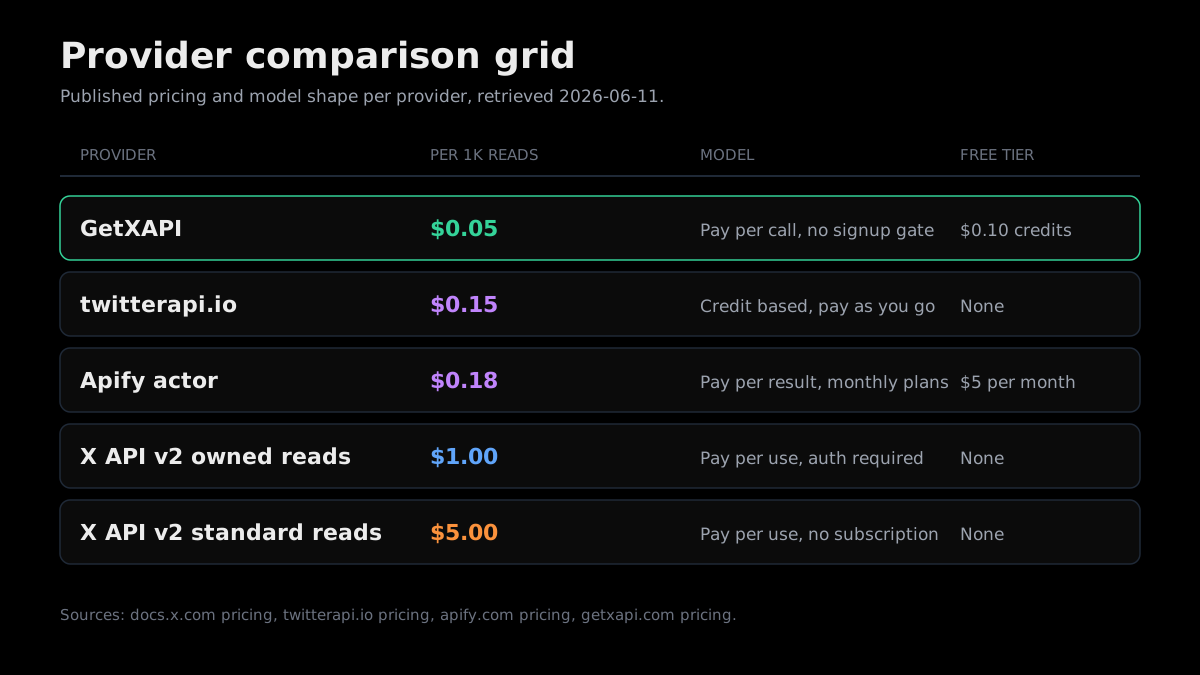
The Twitter API cost comparison comes down to one table. Cost per 1,000 tweet reads is the unit that maps cleanly to a monthly bill, because read volume is what scales as your app grows.
| Provider | Cost per 1,000 tweet reads | Free tier | Minimum spend | Pricing source |
|---|---|---|---|---|
| GetXAPI | $0.05 (measured) | $0.10 credits, about 100 calls | None | getxapi.com/pricing |
| twitterapi.io | $0.15 | None | None (pay as you go) | twitterapi.io/pricing |
| Apify (pay-per-result actor) | $0.18 | $5 credits per month | None | apify.com/pricing |
| RapidAPI (marketplace listings) | $0.10 to $0.50 (varies) | Varies by listing | Varies by listing | RapidAPI listing pages |
| X API v2 (owned reads) | $1.00 | None | None | docs.x.com pricing |
| X API v2 (standard reads) | $5.00 | None | None | docs.x.com pricing |
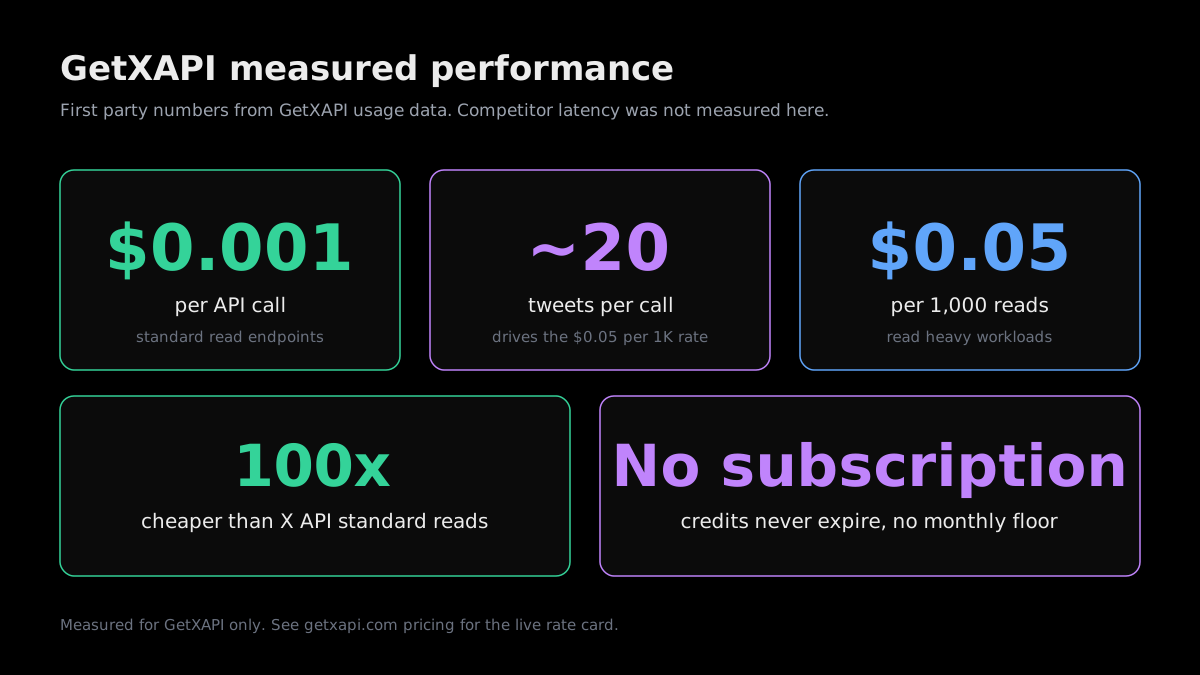
All competitor numbers are published list pricing, retrieved 2026-06-11. The GetXAPI rate is measured from first-party usage: a standard call costs $0.001 and returns roughly 20 tweets, which is what produces the $0.05 per 1,000 figure.
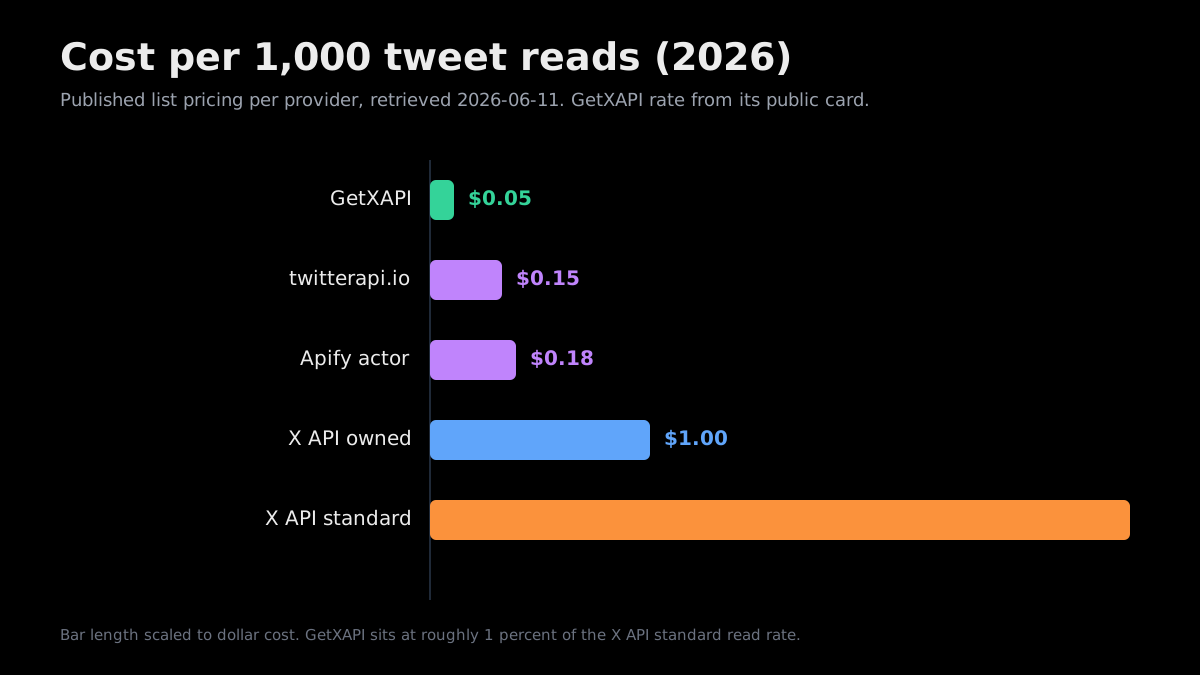
The spread is the headline. GetXAPI at $0.05 per 1,000 reads is roughly 100x cheaper than the X API standard read rate of $5.00 per 1,000, roughly 3x cheaper than twitterapi.io at $0.15, and roughly 3.6x cheaper than the Apify pay-per-result actor at $0.18. For owned-account reads, the official X API at $1.00 per 1,000 is far closer to the third-party field, which matters for one specific workload class covered below.
For a deeper look at how these rates play out across 12 months at different volumes, the Twitter API cost math guide models per-workload spend trajectories. This benchmark is the head-to-head companion to that cost-modeling piece.
What "cost per 1,000 calls" actually measures
Cost per 1,000 calls is the price to make one thousand API requests on a given provider, normalized so providers with different unit models can be compared on one axis. It is the single most useful number for budgeting because a real workload is just a request count multiplied by a rate.
The subtlety is that providers count "a call" differently. The official X API bills per resource read: one tweet read is one charge at $0.005. A direct API like GetXAPI bills per API call, and one call can return a batch of roughly 20 tweets, so the per-tweet cost is far lower than the per-call cost suggests. To compare fairly, this benchmark normalizes everything to cost per 1,000 tweet reads, which is the unit your monthly bill is denominated in regardless of which provider you choose.
Here is the normalization in code, so the math is reproducible rather than asserted.
# Normalize every provider to cost per 1,000 tweet reads.
# GetXAPI is measured; competitor rates are published list pricing (2026-06-11).

providers = {
    "GetXAPI":            {"per_call": 0.001, "tweets_per_call": 20},   # measured
    "X API v2 standard":  {"per_call": 0.005, "tweets_per_call": 1},    # docs.x.com
    "X API v2 owned":     {"per_call": 0.001, "tweets_per_call": 1},    # docs.x.com
}

def cost_per_1k_reads(per_call, tweets_per_call):
    cost_per_tweet = per_call / tweets_per_call
    return round(cost_per_tweet * 1000, 4)

for name, cfg in providers.items():
    print(name, "$%.2f per 1K reads" % cost_per_1k_reads(**cfg))

# GetXAPI            $0.05 per 1K reads
# X API v2 standard  $5.00 per 1K reads
# X API v2 owned     $1.00 per 1K reads
The batch-per-call factor is why a $0.001-per-call API lands at $0.05 per 1,000 reads rather than $1.00. It is also why comparing raw per-call prices across providers is misleading: you have to normalize to the same unit of delivered data first.
GetXAPI: the measured baseline
GetXAPI is a pay-per-call Twitter and X data API that charges $0.001 per standard call, with each standard call returning roughly 20 tweets, which produces a measured cost of $0.05 per 1,000 tweet reads. It requires no X developer account and no subscription, and credits do not expire.
This is the only provider in the benchmark whose performance numbers are measured rather than quoted from a pricing page, because it is the API whose usage data is directly observable here. The $0.05 per 1,000 figure is derived from real call behavior: the per-call price is published on the GetXAPI pricing page, and the roughly-20-tweets-per-call batch size is the measured average that turns that per-call price into a per-1,000-reads rate.
A minimal read call looks like this. The auth model is a single Bearer header, which is the main thing that changes when migrating from another provider.
# GetXAPI: search recent tweets. One call returns a batch (~20 tweets).
curl -s "https://api.getxapi.com/v1/tweets/search?query=twitter%20api%20cost&limit=20" \
  -H "Authorization: Bearer $GETXAPI_KEY"
The same call in Python, which is the shape most data and analytics teams start from:
import os
import requests

GETXAPI_KEY = os.environ["GETXAPI_KEY"]

resp = requests.get(
    "https://api.getxapi.com/v1/tweets/search",
    params={"query": "twitter api cost", "limit": 20},
    headers={"Authorization": f"Bearer {GETXAPI_KEY}"},
    timeout=30,
)
resp.raise_for_status()
tweets = resp.json().get("data", [])
print(f"fetched {len(tweets)} tweets in one $0.001 call")
For a fuller walkthrough of the read endpoints, the Python Twitter API tutorial covers search, timelines, and user lookups end to end, and the GetXAPI best practices guide covers production patterns like pagination and retry. If you are comparing GetXAPI directly against the official API on features rather than just price, the Twitter API v2 vs GetXAPI breakdown is the head-to-head.
The motivation for a direct API like this is a recurring developer story: third-party scrapers and actors are fine until volume climbs, at which point the cost adds up faster than expected. The developer who built GetXAPI described that exact arc in a public launch post.
Twitter's Pricing is Ridiculous! from r/SaaS
The official X API v2: pay per use, no free tier
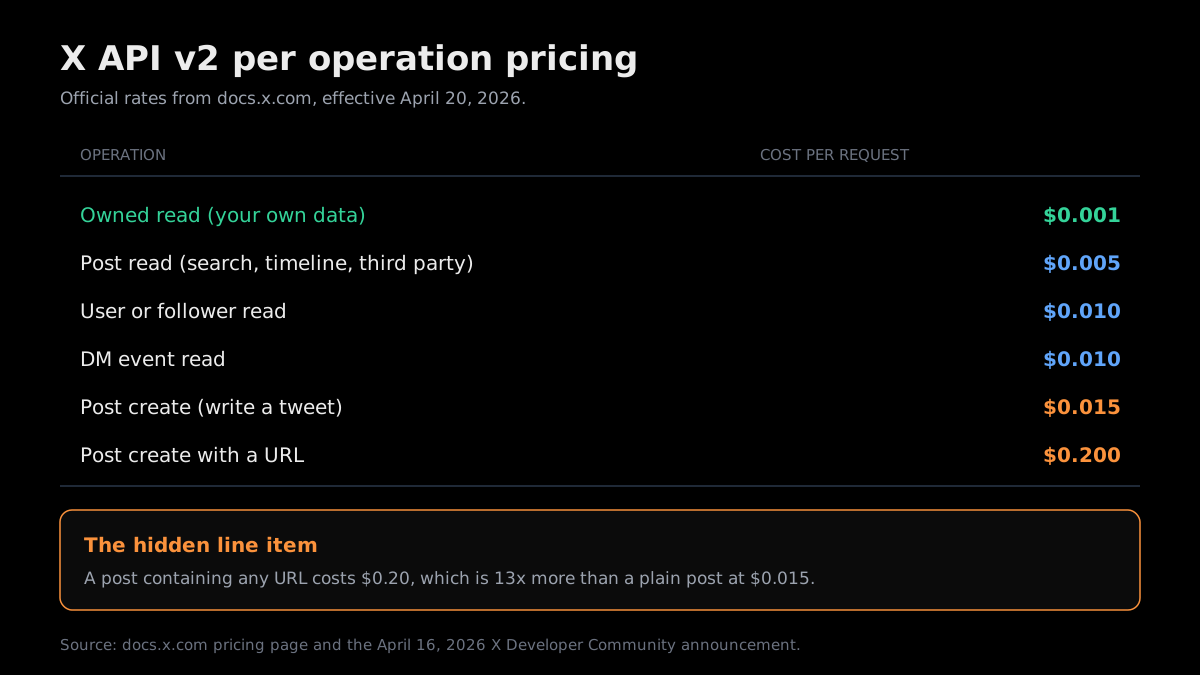
The official X API v2 is X's first-party API, priced pay-per-use with no subscription and no free tier for new developers. Standard tweet reads cost $0.005 each, which is $5.00 per 1,000 reads, while owned-account reads cost $0.001 each, or $1.00 per 1,000, per the published pricing retrieved 2026-06-11.
The official rate is the anchor every other provider compares against. It is also the most expensive read path in this benchmark by a wide margin for non-owned data. The per-operation breakdown matters because writes and user lookups are priced differently from plain reads.
A standard authenticated read on the official API requires an OAuth 2.0 bearer token from a registered X developer app:
# Official X API v2: recent search. Each tweet read is a separate $0.005 charge.
curl -s "https://api.x.com/2/tweets/search/recent?query=twitter%20api%20cost&max_results=20" \
  -H "Authorization: Bearer $X_BEARER_TOKEN"
The pricing math is unforgiving at volume because every tweet is a separate charge. There is no batch-per-call discount the way a direct API delivers it.
# Official X API standard reads: cost scales 1:1 with tweets fetched.
PER_READ = 0.005  # docs.x.com pricing, 2026-06-11

def x_api_monthly_cost(tweets_per_month):
    return round(tweets_per_month * PER_READ, 2)

for vol in [1_000, 10_000, 100_000, 1_000_000]:
    print(f"{vol:>9,} reads/mo -> ${x_api_monthly_cost(vol):,.2f}")

#     1,000 reads/mo -> $5.00
#    10,000 reads/mo -> $50.00
#   100,000 reads/mo -> $500.00
# 1,000,000 reads/mo -> $5,000.00
There is no free tier to soften the entry. For the full picture on why free access disappeared and what survives, the is the Twitter API free guide documents the February 2023 free-tier removal and the current state. The official API also enforces rate limits that are separate from price, which the Twitter API rate limit guide covers in detail.
The cost-shock that pushes developers to compare providers in the first place is well documented in public forums. One developer measured the new pay-per-use model in production and posted the figure: roughly $1 per 200 posts, which confirms the $5.00-per-1,000 standard read rate.
Reliable way to scrape X (Twitter) Search? from r/webscraping
The reaction from developers weighing the official rate against what they get is blunt and consistent:
https://x.com/mreiffy/status/2059878453638209629
The April 2026 pricing change, and why it matters here
On April 16, 2026, X announced changes effective April 20: owned reads dropped to $0.001 per resource and post writes rose to $0.015 per post, with posts containing any URL staying at $0.20. This created the only scenario in the benchmark where the official API is cost-competitive with third-party providers: reading your own account's data.
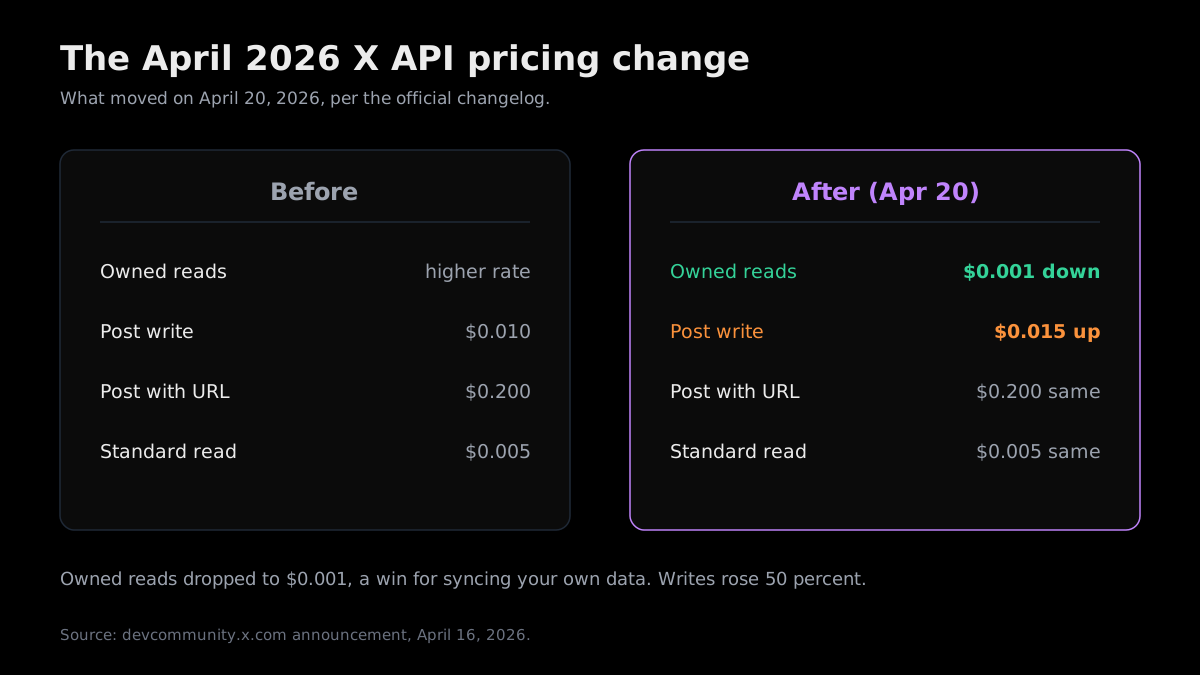
The owned-reads reduction is genuinely significant for a narrow workload class. If your application reads only your own timeline, your own followers, or your own DMs, the official X API at $1.00 per 1,000 owned reads is now in the same order of magnitude as third-party APIs. For everything else, search, competitive monitoring, brand sentiment on accounts you do not own, third-party enrichment, the standard $5.00-per-1,000 rate still applies and third-party APIs remain far cheaper. The full timeline and developer reaction is documented in the X API pricing change 2026 analysis.
A widely-shared analyst breakdown framed the broader cost story bluntly, noting that for typical use the new pay-per-use math can land higher than the old $200 Basic plan it replaced:
https://x.com/aakashgupta/status/2019991413442900046
The write side moved the other way. At $0.015 per post and $0.20 per post containing a URL, high-volume posting applications got meaningfully more expensive. The factuality note here is important: these are the official published numbers as of 2026-06-11, and X has changed this pricing twice in roughly a year, so re-check the docs.x.com pricing page before locking a budget.
Start building with GetXAPI
$0.05 per 1,000 tweets. $0.10 free credits. No credit card required.
twitterapi.io: the mid-priced direct alternative
twitterapi.io is a third-party Twitter data API that bills on a credit model, with tweet reads priced at $0.15 per 1,000 tweets per its published pricing retrieved 2026-06-11. It sits between the official API and the cheapest direct APIs on cost.
On the published pricing page, the rate works out to 15 credits per tweet where $1 buys 100,000 credits, which is $0.15 per 1,000 tweets. User profile reads are priced higher at roughly $0.18 per 1,000 profiles. There is no free tier, but there is no monthly minimum either, so it behaves like a pure pay-as-you-go option at a mid-tier rate.
# twitterapi.io: published rate is 15 credits per tweet, $1 = 100,000 credits.
CREDITS_PER_DOLLAR = 100_000      # twitterapi.io/pricing, 2026-06-11
CREDITS_PER_TWEET = 15            # published

cost_per_1k = (CREDITS_PER_TWEET * 1000) / CREDITS_PER_DOLLAR
print(f"twitterapi.io: ${cost_per_1k:.2f} per 1,000 tweet reads")
# twitterapi.io: $0.15 per 1,000 tweet reads
twitterapi.io is a reasonable middle option: cheaper than the official API by roughly 33x on reads, more expensive than the cheapest direct APIs by roughly 3x. If you are already on twitterapi.io and weighing a move, the migrate from twitterapi.io to GetXAPI guide walks through the mechanical swap, which is mostly a base-URL and auth-header change.
Apify: pay per result, but watch the expiring credits
Apify is a scraping platform whose pay-per-result Twitter scraper actor charges $0.18 per 1,000 tweets, per the published actor listing and platform pricing retrieved 2026-06-11. The platform also sells monthly plans, $29 Starter and $199 Scale, whose credits expire monthly.
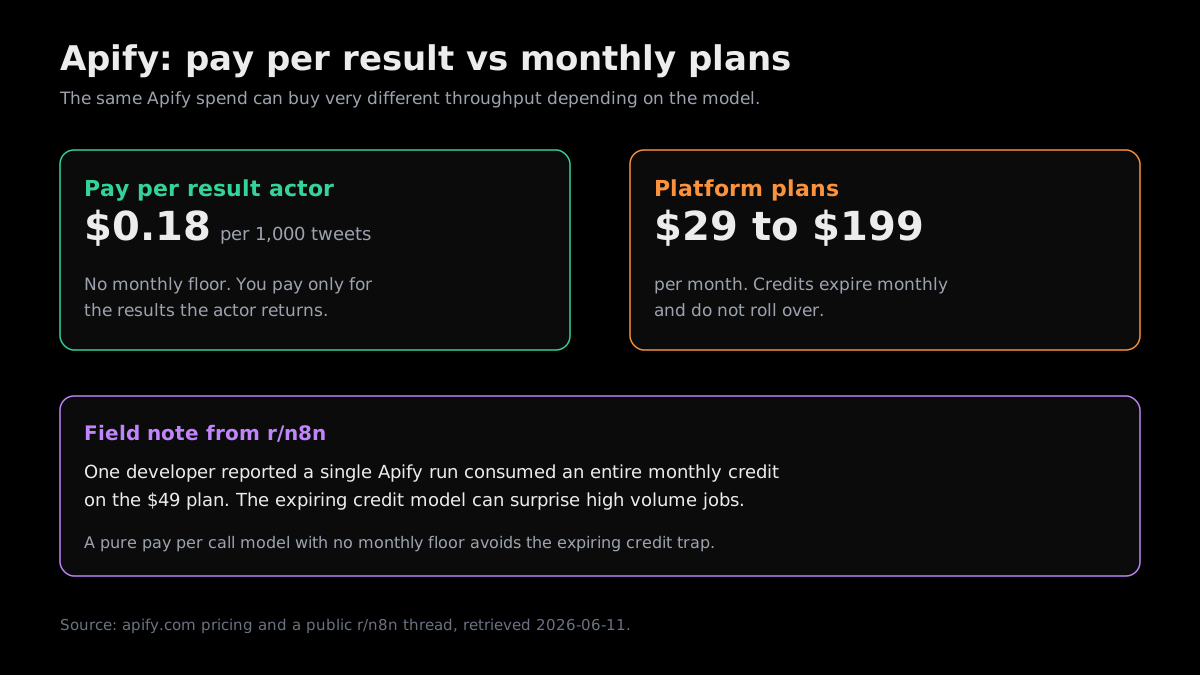
The pay-per-result actor rate of $0.18 per 1,000 tweets is the cleanest number to compare, and it is roughly 28x cheaper than the official X API standard read rate. The complication is the platform model layered on top. Apify's subscription credits expire at the end of each month and do not roll over, which means an unpredictable or bursty workload can burn an entire monthly allowance in a single large run.
# Apify: pay-per-result actor rate vs an expiring monthly credit pool.
ACTOR_RATE_PER_1K = 0.18          # apify.com pay-per-result actor, 2026-06-11
STARTER_PLAN = 29.0              # monthly, credits expire end of month

def actor_cost(tweets):
    return round((tweets / 1000) * ACTOR_RATE_PER_1K, 2)

# A single 200K-tweet run on the actor model:
print("200K-tweet run:", f"${actor_cost(200_000)}")  # $36.00
# On a $29 expiring-credit plan, one big run can exhaust the month's credits.
This is the exact failure mode developers report in practice. A public r/n8n thread describes a single Apify run consuming an entire monthly credit on the $49 plan, which is the kind of surprise that pushes high-volume teams toward a pay-per-call model with no expiring pool. For a direct head-to-head on cost and reliability, the Apify Twitter scraper vs GetXAPI comparison goes deeper, and the best Twitter API for scraping guide places Apify against browser and library approaches.
An automation walkthrough shows the cheaper-than-official-API pattern in a real workflow, with Apify in the loop for the scraping step:
https://www.youtube.com/watch?v=otK0ILpn4GQ
RapidAPI: a marketplace, not a single price
RapidAPI is an API marketplace that hosts many third-party Twitter listings from different publishers, so there is no single RapidAPI Twitter price. Verified listings commonly fall in the $0.10 to $0.50 per 1,000 calls range depending on the publisher and plan tier.
This is the one provider in the benchmark that resists a single number, and stating a fake-precise figure would be dishonest. The marketplace bundles its fee into the listed price, so a publisher who would charge $0.16 per 1,000 on their own site often shows $0.20 on RapidAPI for the same endpoint. Per-call costs across the common Twitter listings translate to roughly $0.10 to $0.50 per 1,000 calls, which is the verified range rather than a point estimate.
# RapidAPI Twitter listings: a verified range, not one price.
# Pricing varies by publisher and plan tier; do not hardcode a single number.
RAPIDAPI_RANGE_PER_1K = (0.10, 0.50)   # verified range across common listings

low, high = RAPIDAPI_RANGE_PER_1K
print(f"RapidAPI Twitter listings: ${low:.2f} to ${high:.2f} per 1,000 calls")
# Always size against the specific listing's current plan page, not the range.
The structural tradeoff is reliability, not just price. You do not control which marketplace listing is well maintained this quarter, and a listing that is excellent today can degrade after the publisher loses focus or gets acquired. The RapidAPI Twitter alternative guide covers the marketplace mechanics, the outage patterns, and the one-hour migration path to a direct API in full.
Worked example: 100,000 tweet reads per month
To make the benchmark concrete, here is the all-in read cost at 100,000 tweet reads per month, a volume typical for a mid-size monitoring or research pipeline. This volume maps cleanly to each provider's published rate because all five pricing models scale linearly with read count.
| Provider | 100,000 reads per month | Source |
|---|---|---|
| GetXAPI | $5 (measured) | getxapi.com/pricing |
| twitterapi.io | $15 | twitterapi.io/pricing |
| Apify (actor) | $18 | apify.com/pricing |
| X API v2 (owned reads) | $100 | docs.x.com pricing |
| X API v2 (standard reads) | $500 | docs.x.com pricing |
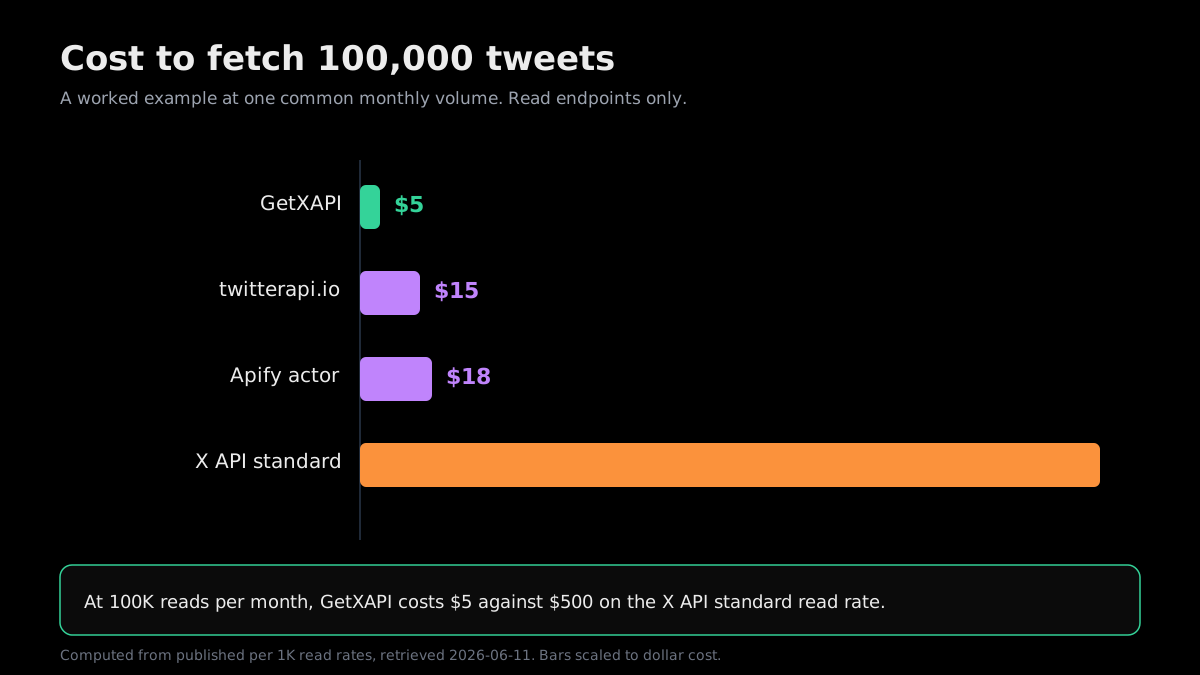
The absolute spread at 100,000 reads is the clearest way to see the benchmark: $5 on GetXAPI against $500 on the X API standard read rate is the 100x gap stated as a monthly bill. And because all of these rates scale linearly, the dollar gap only widens as volume climbs.
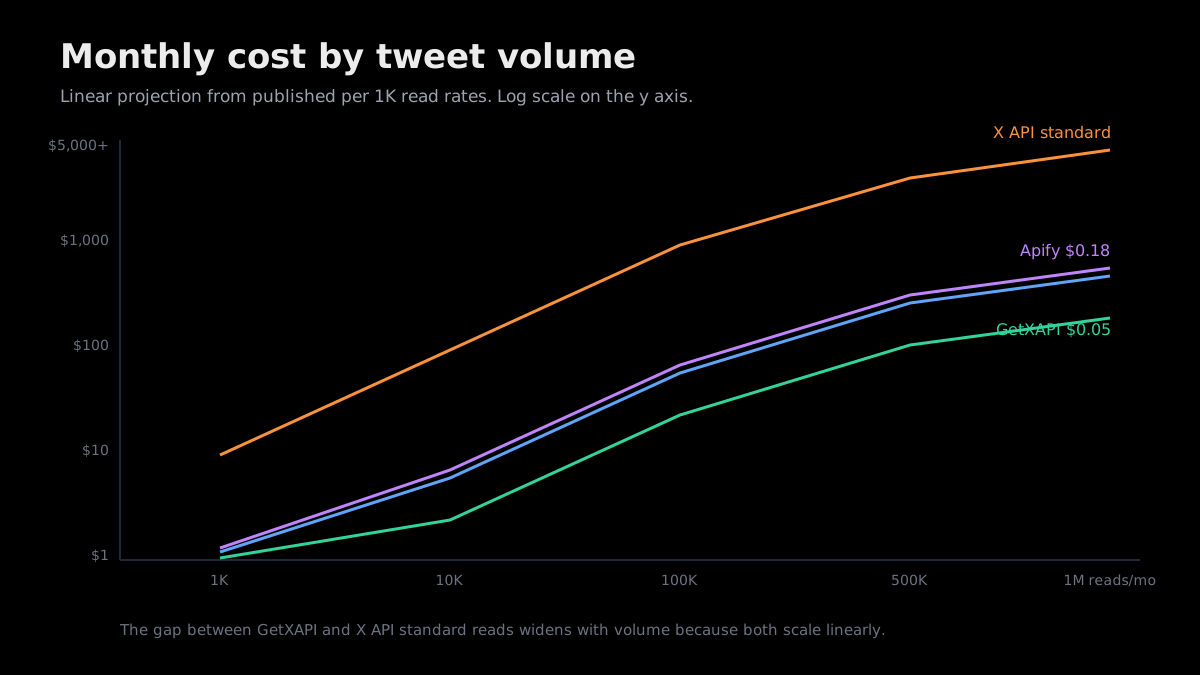
How to choose: match the provider to the workload
The cheapest provider depends entirely on what you are reading and why. There is no single winner, because the official owned-read rate, the third-party read rate, and the compliance-bound use case each favor a different provider.
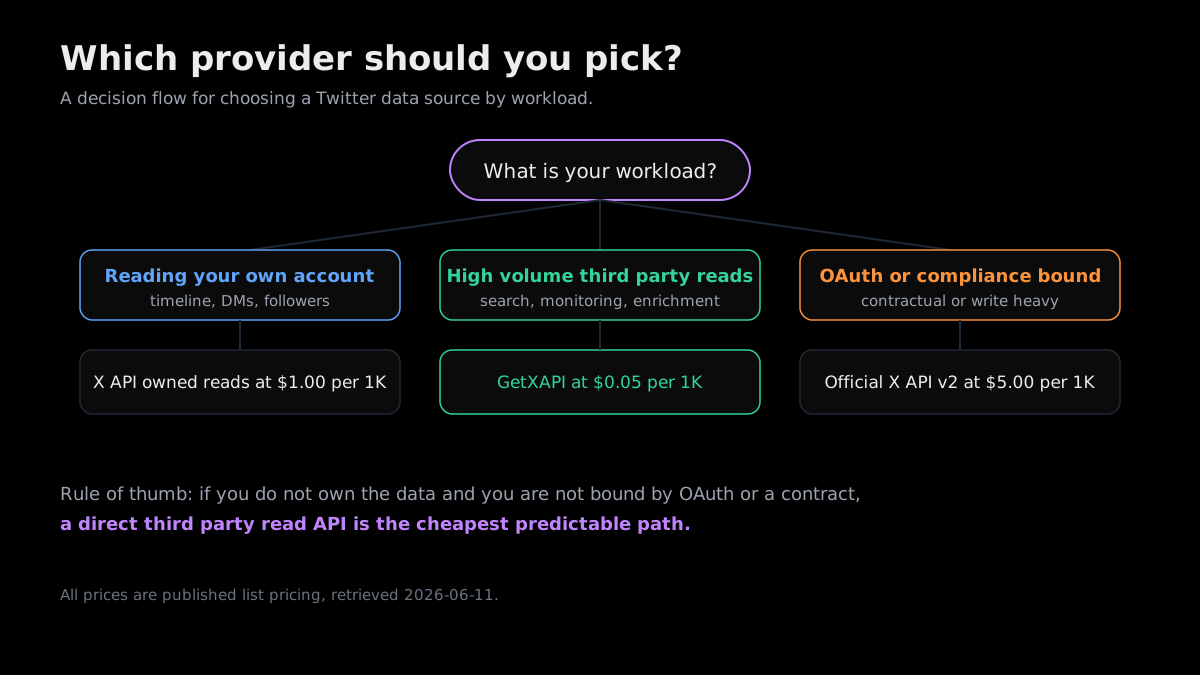
The decision splits cleanly into three branches:
- Reading your own account data (timeline, DMs, followers): the official X API owned-read rate at $1.00 per 1,000 is competitive and gives you first-party compliance. The follower export guide covers this workload.
- High-volume third-party reads (search, monitoring, enrichment): a direct API like GetXAPI at $0.05 per 1,000 is the cheapest predictable path. The scrape tweets guide and the sentiment analysis guide cover common read-heavy use cases.
- OAuth or compliance-bound work: the official X API v2 at $5.00 per 1,000 standard reads is the right answer when a contract or user-delegated OAuth flow is non-negotiable, despite the cost.
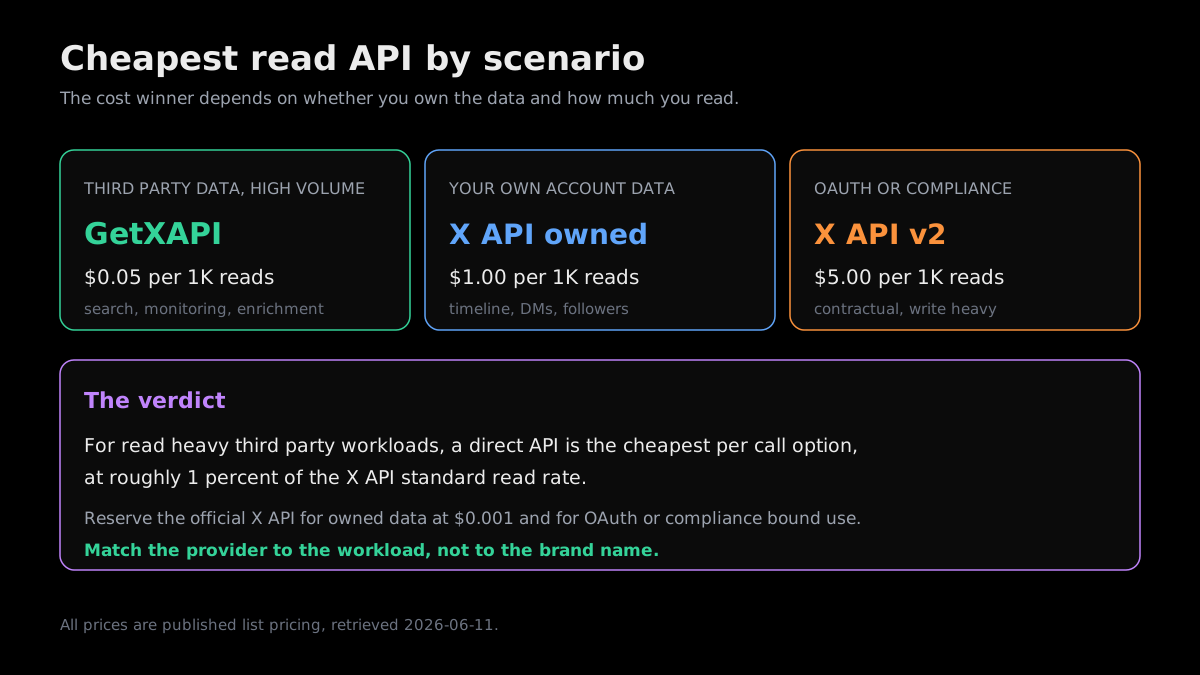
If your workload is write-heavy rather than read-heavy, the calculus shifts again because of the $0.015 per post and $0.20 per post-with-URL rates. The send Twitter DMs via API guide and the advanced search operators reference cover the write and query-construction sides. And before you commit to any provider, the how to get a Twitter API key guide covers the setup friction that the official portal adds and that direct APIs skip.
A cost-reduction walkthrough makes the same point from the practitioner side: the largest savings come from picking the right provider for the workload before optimizing within it.
The cheapest Twitter API. Try it free.
$0.05 per 1,000 tweets. $0.10 free credits. No credit card required.
Reads versus writes: the asymmetry that decides your bill
Most cost comparisons quietly assume read traffic, because reading public tweets is the dominant use case for data, analytics, and monitoring. But the April 2026 restructuring concentrated cost on the write side, so if your project posts at volume the read benchmark above understates your real bill. It is worth pulling the write rates out explicitly so the two sides do not get conflated.
On the official X API, a plain post write costs $0.015 and a post containing any URL costs $0.20, per the official changelog. That $0.20 figure is the one that surprises people, because a link-bearing post costs more than thirteen times a plain post. A newsletter relay or RSS-to-X bot that always includes a URL pays the link rate on every single post. At 10 link-posts a day that is roughly $60 a month; at 100 a day it is roughly $600 a month, on output that used to cost a few dollars under the old flat rate.
The asymmetry is the planning lesson. A read pipeline and a posting bot are different products with different economics, and bundling them onto one expensive tier is what made the April change hurt. The cheapest design splits them: route reads through a per-call read API at $0.05 per 1,000, and keep writes on the first-party API where posting is the only first-party route, auditing how many of those posts truly need an inline URL. The X API pricing change analysis covers the write-side workarounds, including moving the link to a reply to dodge the $0.20 band, in full.
This benchmark holds the comparison to reads on purpose, because reads are where third-party providers create the widest cost gap and where most projects spend most of their request budget. If your workload is write-heavy, treat the read table as one input and price the write actions separately at the rates above.
The free tier and free credits, compared
A recurring question behind the cost comparison is whether any of these providers are free to start. The short answer is that the official X API has no free read tier for new developers, while some third-party providers seed a small free credit so you can test before spending.
The official pay-per-use model requires buying credits upfront, with no standing free monthly read allowance, per the official pricing page. The remaining free Basic tier is write-limited with a small monthly post cap and no meaningful read access, so it is not a workable home for reading public data at any volume. On the third-party side, GetXAPI seeds new accounts with $0.10 in free credits, about 100 standard calls, with no credit card required, and the Apify free plan includes $5 in monthly platform credits. twitterapi.io has no free credit but also imposes no monthly minimum, so it behaves as pure pay-as-you-go.
The takeaway is that the free allowances are for evaluation, not for running a workload free. They are enough to confirm a key works and check the response shape, which is the right way to validate a provider before you commit any budget. Size the real cost against the per-1,000 table, not the free credit, because the free credit runs out fast at any production volume.
How this benchmark differs from the other pricing guides
Most of the well-ranked Twitter API pricing guides explain one provider's billing in depth and stop there, which is useful but leaves the cross-provider question unanswered. It is worth naming what those guides cover so you know where to go for the parts this benchmark does not re-derive.
The Blotato 2026 pricing guide is a thorough walk through the official X API tiers, including the legacy Basic and Pro plans that are now closed to new signups, and it flags the $0.20 per-link-post detail that catches automated publishers off guard. The PostProxy X API pricing breakdown focuses on read-heavy cost calculation under the pay-per-use model, which pairs well with the worked example above. The Zernio pricing explainer covers the $0.005-per-request read math from the angle of a competing alternative. What none of them do is put GetXAPI, twitterapi.io, Apify, and the official API in one normalized cost-per-1,000-reads table, which is the specific gap this post fills.
The reason the gap exists is that most of these guides are published by a single provider with an interest in framing the comparison a certain way. A benchmark that names a measured first-party rate for one provider and published list pricing for the rest, each with a dated source URL, is auditable in a way a single-vendor explainer is not. The point is not that the other guides are wrong, it is that they answer a narrower question: how does this one provider bill, rather than which provider is cheapest for my workload.
For background on what the X API actually is and how the credit system fits into the broader product, the official About the X API page is the canonical reference. Read it alongside the pricing page, because the credit mechanics and the per-action rates are documented separately and the bill depends on both.
Why API pricing keeps moving, and how to insulate against it
A cost benchmark is a snapshot, and the single most important caveat is that the snapshot expires. The official X API has repriced twice in roughly a year, and every comparison in this post carries a retrieval date for exactly that reason. Budgeting against a number you read once is how a project gets surprised by a bill.
This is not unique to X, and it is not new to X either. Twitter first ended free API access in February 2023, then announced the Free, Basic, and Enterprise tier structure that priced out a wave of independent developers, before the April 2026 move to pay-per-use that Social Media Today covered as a usage-based access charge. The most-cited cross-platform precedent is Reddit's 2023 API repricing, reported widely at the time, which shut down a generation of third-party clients almost overnight once the dependent ecosystem was large enough to monetize. The shape repeats across platforms: cheap or free access to grow the ecosystem, then a price that captures value once developers are committed. The specific dollar figures differ, but the cycle is predictable enough to plan around.
The practical insulation is architectural, not contractual. Abstract your data access behind a thin internal interface so the provider underneath is a configuration choice, not a dependency woven through your codebase. A project that calls a platform API directly in fifty places faces a rewrite when the price changes; a project that calls its own wrapper changes one module. Combined with knowing which of your workloads are read versus write, and keeping a tested fallback provider ready, a repricing event becomes an inconvenience instead of an outage. The benchmark numbers will drift. The discipline of dated sourcing and loose coupling is what keeps the drift from hurting.
A second insulation is to right-size the unit you budget in. Teams that think in monthly subscription tiers get surprised when a bursty workload blows through an expiring credit pool, which is the Apify failure mode developers report. Teams that think in cost per 1,000 reads, with no monthly floor, can size capacity by budget and let usage track demand. That is the deeper reason the per-call model tends to win for unpredictable read workloads: it removes the mismatch between a fixed monthly commitment and a variable real-world request count.
The verdict
For read-heavy third-party Twitter workloads, the cheapest Twitter API in 2026 at published list pricing is a direct API: GetXAPI at a measured $0.05 per 1,000 reads, roughly 100x below the official X API standard read rate of $5.00. twitterapi.io at $0.15 and the Apify actor at $0.18 are the mid-tier direct options, and RapidAPI marketplace listings land in a verified $0.10 to $0.50 range that varies by listing.
The official X API earns its place in exactly two situations: owned-account reads, where the $0.001 owned rate is now competitive, and OAuth or compliance-bound work, where a contract makes the price secondary. For everything else, the benchmark is unambiguous, and the savings compound with volume. Match the provider to the workload, and re-check the published pricing pages, because the official rate has moved twice in roughly a year.
If you want to run your own numbers, plug your projected mix into the cost calculator, and see the live rate card on the pricing page.
Frequently Asked Questions
The official X API v2 charges $0.005 per post read, which works out to $5.00 per 1,000 tweet reads at published list pricing as of 2026-06-11. For owned reads, the rate drops to $0.001 per resource, or $1.00 per 1,000. Third-party providers run far cheaper: twitterapi.io charges $0.15 per 1,000 tweets, Apify's pay-per-result actor charges $0.18 per 1,000 tweets, and GetXAPI charges $0.05 per 1,000 tweets through its $0.001-per-call standard endpoint, where each call returns roughly 20 tweets.
Based on published list pricing as of 2026-06-11, GetXAPI is the cheapest per tweet read at $0.05 per 1,000 tweets, which is $0.001 per API call with each call returning roughly 20 tweets. twitterapi.io is next at $0.15 per 1,000 tweets, followed by Apify's pay-per-result actor at $0.18 per 1,000. The official X API costs $5.00 per 1,000 standard reads, making GetXAPI roughly 100x cheaper for read-heavy workloads.
On April 16, 2026, X announced two changes effective April 20: owned reads dropped from a higher rate to $0.001 per resource, a win for developers accessing their own account data, while post creation writes increased to $0.015 per post, up from $0.010. Posts containing any URL remained at $0.20 per post. The owned-read reduction helped use cases like syncing your own timeline, while the write increase made high-volume posting apps meaningfully more expensive, per the official X Developer Community announcement.
No. GetXAPI is a direct third-party API that you call with a single Bearer token from your GetXAPI account. You do not need an X or Twitter developer account, you do not go through the X developer portal, and you do not manage OAuth app registration. Signup at getxapi.com issues a key and $0.10 in free credits without a credit card, which is enough for about 100 standard calls to test the read endpoints before you spend anything.
No. As of 2026 the official X API has no free tier for new developers. The pay-per-use model requires purchasing credits upfront, with no monthly minimum but no free allowance either. Some third-party providers offer a small free credit at signup: GetXAPI gives new accounts $0.10 in free credits, about 100 API calls, without requiring a credit card, and Apify's free plan includes $5 in monthly platform credits per its published pricing.
Apify's pay-per-result Twitter scraper actor charges $0.18 per 1,000 tweets at published pricing, which is roughly 28x cheaper than the official X API's $5.00 per 1,000 standard reads. However, Apify's platform plans, $29 per month Starter and $199 per month Scale, have credits that expire monthly and cannot be rolled over. For developers running high-volume or unpredictable workloads, a pure pay-per-call model with no monthly floor, like GetXAPI at $0.001 per call, often works out cheaper than Apify's subscription tiers.
Usually yes, but the savings are not fixed. RapidAPI is a marketplace that hosts many third-party Twitter listings, and per-call pricing varies by the listed provider and plan. Verified RapidAPI Twitter listings commonly land in the $0.10 to $0.50 per 1,000 calls range depending on the tier, which is cheaper than the official X API at $5.00 per 1,000 standard reads but typically more than a direct API like GetXAPI at $0.05. Because the marketplace bundles a fee into the listed price, the same publisher is often cheaper on their own site.
Multiply your monthly read volume by the per-1,000 rate for your provider. At published pricing, 100,000 tweet reads per month costs about $500 on the X API standard read rate, $18 on Apify's pay-per-result actor, $15 on twitterapi.io, and $5 on GetXAPI. Add user-profile lookups, writes, and DM operations at their own rates. On the official X API, factor in the 24-hour deduplication window, which means re-fetching the same resource within one UTC day does not incur a second charge.
Check out similar blogs
More guides on the Twitter/X API, scraping, and pricing.

Post Tweets via API With Authentication in 2026 (No Developer Account)
Post tweets, threads, and media through an API without an X developer account. The auth_token model, working Python and Node code, rate-limit safety, and per-call costs.

Twitter API Performance Benchmark 2026: Latency, Reliability, Throughput
A real Twitter/X API performance benchmark: measured per-endpoint latency (p50/p95), 100% reliability across 44 calls, and throughput math, with how it compares to the official API.

How to Detect X (Twitter) Bots: A Practical, Data-Backed Method
A practitioner method for Twitter bot detection: the real signals (views-to-likes ratio, account age, posting cadence, follower pattern, amplification), runnable API code to pull each one, and a scoring rubric you own.

Is the Twitter API Free in 2026? What the Free Tier Actually Gives You
The X API free tier is write only: 1,500 posts a month, zero read access. Here is the full 2026 cost ladder and where pay-per-call APIs fit for read-heavy work.

Twitter API Rate Limits Explained: Windows, 429s and How to Avoid Them
The X API enforces 15-minute and 24-hour rate limit windows per endpoint. This guide covers the per-endpoint table, 429 response headers, retry-with-backoff patterns, and how pay-per-use changes (and does not change) your limits.

Twitter API Tutorial 2026: The Complete Developer Guide
The 2026 Twitter API tutorial built after the pricing collapse. Auth, endpoints, code, rate limits, real costs, and the alternative when official gets too expensive.
RapidAPI Twitter Alternative: Direct API vs Marketplace
Picking a RapidAPI Twitter alternative? Compare marketplace listings against the official X API and GetXAPI on price, uptime, billing, and migration.

How to Monitor Twitter (X) Accounts with an API (2026 Guide)
Monitor X accounts for new tweets, mentions, and profile changes with a pay-per-call API. Polling patterns, code, alert wiring, scale math, and what it costs in 2026.